


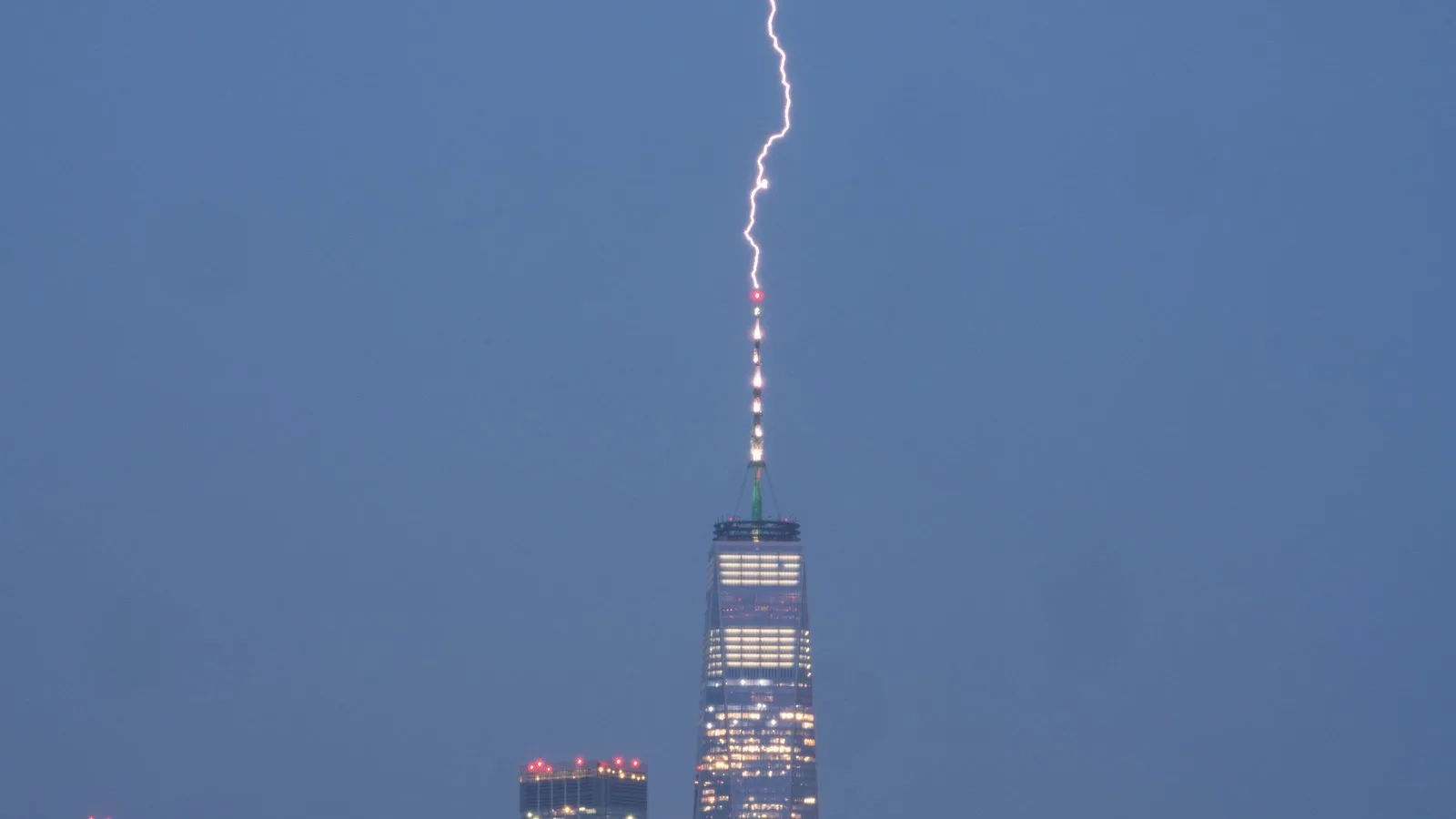
Lightning never strikes the same place twice. It is one of the most repeated weather sayings in the world, used to mean that freak events do not repeat themselves. The only problem is that it is not true. Lightning strikes the same place again and again, and tall buildings are hit dozens of times a year. Verdict: False.
The building that gets hit every year
The National Weather Service in the United States lists "lightning never strikes the same place twice" on its official page of lightning myths, and its answer is blunt: lightning often strikes the same place repeatedly, especially if it is a tall, pointy, isolated object. Its example is the Empire State Building in New York, which is hit an average of 23 times a year. NOAA, the US National Oceanic and Atmospheric Administration, puts the figure at about 25 times a year.
The building does not just get hit once a year and then left alone. During one storm it was struck eight times in 24 minutes. Video footage from April 2011 recorded lightning striking the Empire State Building several times in the space of a few minutes. The building was once even used as a lightning laboratory, because it is hit nearly 25 times a year and researchers could count on it being struck.
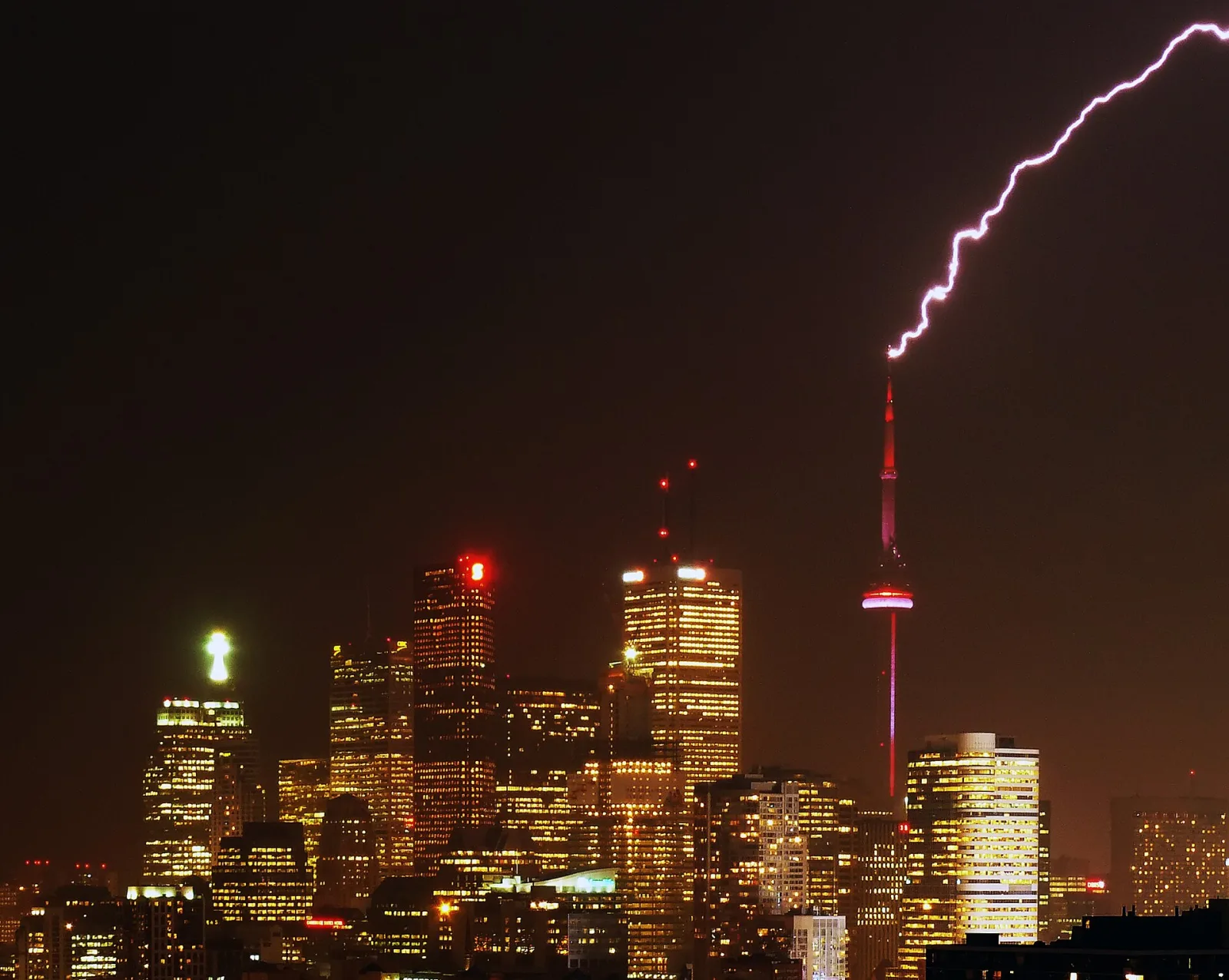
New York is not special. The CN Tower in Toronto, a 553 metre concrete shaft topped by a steel antenna mast, takes about 75 strikes a year according to its operators. When researchers counted flashes optically over many seasons rather than estimating, the long run average came out closer to 36 a year, in a study published in the Journal of Atmospheric and Solar-Terrestrial Physics. On the night of 24 August 2011, two cameras recorded 52 flashes hitting the tower in a little over 84 minutes, roughly one every 99 seconds. In an hour and a half, the CN Tower absorbed more lightning than it normally sees in a year.
Why tall things get hit again and again
Lightning does not pick its target at random, and it does not keep a tally of places it has already visited. What decides where a strike lands is height, shape and isolation.
Most lightning flashes start inside a cloud, and a channel forms to carry electric charge down toward the ground. When that channel gets within about 100 yards of the ground, objects on the ground start sending sparks upward to meet it. Tall objects like skyscrapers, radio towers, trees and even mountains are far more likely to produce the spark that meets the channel, so the current travels through the channel and into whatever produced the spark. A tall, pointed, isolated object is simply the easiest meeting point in the landscape, storm after storm.
That is also the whole principle behind the lightning rod. A rod is designed to be struck again and again, giving the charge a safe conductive path to the ground so the building itself is not damaged. If lightning truly never struck the same place twice, lightning rods would be useless after their first strike.
Even a single bolt breaks the saying. What we call one flash is usually several discharges running down the same ionised channel a few hundredths of a second apart, which is why lightning flickers instead of just flashing once. NOAA's National Severe Storms Laboratory notes that a negative cloud to ground flash can contain as many as 20 return strokes. One strike, by the plain meaning of the word, has already hit the same spot twenty times before the thunder arrives.
The man struck seven times
Buildings are not the only repeat targets. Roy Cleveland Sullivan was a park ranger in Shenandoah National Park in Virginia, and between 1942 and 1977 lightning found him seven separate times. He survived all seven strikes and holds the Guinness World Record for the most lightning strikes survived by one person.
That is all the more remarkable because being struck even once is rare. In the United States, the odds of being struck by lightning are about 1 in 15,300. Sullivan beat those odds seven times over, in the same park, doing the same job.
Machines are not spared either. On 14 November 1969, the Saturn V rocket carrying the Apollo 12 mission was struck by lightning twice, only 16 seconds apart, just after takeoff. The strikes knocked out the spacecraft's electrical systems and sent its warning lights into chaos, though the crew recovered and the mission went on to the Moon. If lightning respected a one strike rule, the second bolt could never have happened.
Why the saying survives
The saying survives because it was never really about the weather. It is an idiom, a way of saying that a freak event will not repeat itself for the same person in the same place. As a piece of folk wisdom about luck, it sounds comforting. As a statement about lightning, it is simply wrong.
It survives for a second reason too: most people never see the same place struck twice, because they do not watch the same tower through every storm. Each strike lasts a fraction of a second, and almost nobody is watching at the exact moment. The evidence is in the instruments and the records, not in what any one person happens to see.
The myth is also bundled with other dangerous lightning beliefs. The National Weather Service lists several alongside it: that crouching down in an open field will reduce your risk, that you should shelter under a tree, and that a lightning victim is electrified and unsafe to touch. None of these is true. Standing under or near a tree is the second most dangerous place to be during a thunderstorm, after being out in the open, and a lightning victim carries no charge and needs first aid at once. If you are caught outside, the safe move is to get to a substantial building or a hard topped vehicle, and to stay there until the storm has passed.
Verdict: False
Lightning does strike the same place twice, and then again, and again. The Empire State Building is hit about 25 times a year, the CN Tower dozens of times, and one park ranger was struck seven times in 35 years. Height, shape and isolation decide where lightning lands, and a tall, pointed object will draw strike after strike. The saying is false, and believing it can be dangerous.
Frequently Asked Questions
How often is the Empire State Building struck by lightning?
The National Weather Service says it is hit an average of 23 times a year, and NOAA puts the figure at about 25 times a year. During one storm it was struck eight times in 24 minutes, and video from April 2011 shows it being hit several times within a few minutes.
Can the same person be struck by lightning more than once?
Yes. Roy Cleveland Sullivan, a park ranger in Shenandoah National Park in Virginia, was struck seven times between 1942 and 1977 and survived every strike, a Guinness World Record. The odds of being struck once in the United States are about 1 in 15,300.
Why does lightning hit the same place repeatedly?
Height, shape and isolation decide where a strike lands. Tall, pointed, isolated objects send sparks upward to meet the descending channel, so the current lands on them storm after storm. Lightning rods work on the same principle: they are designed to be struck again and again so the building is not.
Read More: Myths and Facts: Bats Are Not Blind, They Can See Well
Read More: Myths and Facts: Ostriches Do Not Bury Their Heads in the Sand
Read More: Myths and Facts: The Great Wall of China Is Not Visible From Space
Read More: Myths and Facts: Chameleons Do Not Change Colour to Match Their Background

Comments
Be the first to comment on this story.