


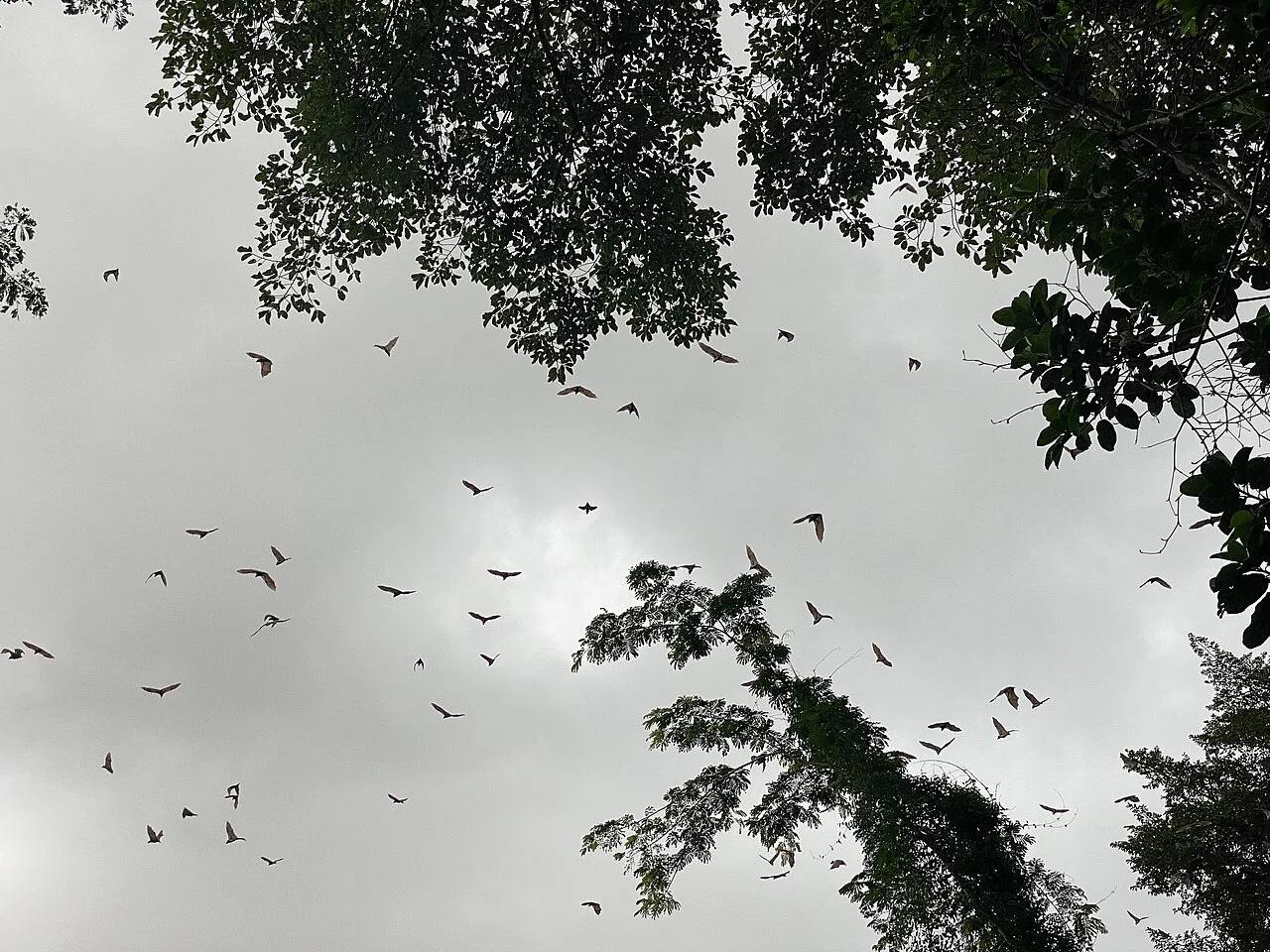
"Blind as a bat" is one of the oldest sayings in English, and most people take it at face value: bats fly in the dark, so they must not be able to see. It sounds like common sense, but the evidence says otherwise. Bats are not blind. Every one of the roughly 1,400 known bat species has working eyes, and many of them see very well. Verdict: False.
The myth
The claim is simple: bats cannot see, and they navigate entirely by echolocation, the sonar system that lets them build a picture of their surroundings from echoes. It feels true because bats hunt in darkness where human eyes fail, and because echolocation is so remarkable that it seems to make vision unnecessary. But the two senses are not rivals. In bats, sight and sound work together, and neither one replaces the other.
What bats actually see
Bat eyes are built like other mammalian eyes, but tuned for dim conditions. Most species have large lenses and wide pupils that let in as much light as possible, and their retinas are packed with rod cells, the photoreceptors that respond to faint light. That makes their night vision better than ours in many cases. Some fruit bats have vision reported to be three times better than human vision in low light, and some species can even see ultraviolet light, which helps nectar-feeding bats find flowers that reflect it.
The differences between bat groups are large. Fruit bats, also called megabats or flying foxes, have big, well-developed eyes and rely mainly on vision and smell to find fruit and navigate at night. Most of them do not echolocate at all. Smaller insect-eating bats, called microbats, have smaller eyes and rely heavily on echolocation for hunting, but their eyes still work. Research shows that bats sometimes prefer using eyesight over sound when hunting, depending on the conditions.
Echolocation and vision work together
Echolocation is a sophisticated biological sonar. Most microbats produce high-frequency sound pulses, usually above 20 kilohertz and beyond the limit of human hearing, and judge distance, size, shape and direction from the returning echoes. It is precise enough to track a tiny moth in complete darkness, and it is the reason the blindness myth survives: a sense that good seems to leave no room for eyes.
In practice, the two senses divide the work. Echolocation is best at short range, for pinpointing small, moving prey. Vision is better at long range, for detecting large, stationary objects such as cliffs and trees, and for navigating between a roost and a feeding site. Microbats use their eyes for long-distance navigation and for spotting predators, and they orient themselves by light sources such as the setting sun when they leave their roosts at dusk. Brain studies back this up: bats have well-developed visual processing regions, which would be pointless if their eyes did not work.
Why the saying stuck
The myth likely grew from two facts that were easy to misread. First, bats are nocturnal, so people rarely see them use their eyes in daylight. Second, the discovery of echolocation was so striking that it was treated as a replacement for vision rather than an addition to it. The phrase "blind as a bat" then did the rest, turning a guess into a saying that sounded like knowledge. It also hides a real problem: bats face serious threats, including white-nose syndrome, which has killed millions of hibernating bats in North America since 2006, and the loss of their roosts. A myth that makes bats sound broken makes it easier to ignore those threats.
The verdict
False. Bats are not blind. All 1,400 known species have functional eyes, fruit bats rely on sharp vision to find food, and even the insect-eating bats that echolocate still use their eyes to navigate and spot danger. Echolocation is an extra sense, not a substitute for sight.
Frequently Asked Questions
Are bats really blind?
No. All bats can see. Every one of the roughly 1,400 known species has functional eyes, and none is blind in any biologically meaningful sense.
Do bats use echolocation instead of sight?
No, they use both. Echolocation is best for tracking small prey at close range in darkness, while vision handles long-distance navigation and large objects. Fruit bats mostly do not echolocate at all and rely on sight and smell.
Can bats see in colour?
Many bats have the cone cells needed for colour vision, and some species can see ultraviolet light. Fruit bats in particular have large, cone-rich eyes, and research suggests some of them see colour.
Read More: Myths and Facts: Cold Weather Does Not Cause Colds
Read More: Myths and Facts: You Do Not Need Eight Glasses of Water a Day
Read More: Myths and Facts: Alcohol Does Not Kill Your Brain Cells
Read More: Myths and Facts: We Use All of Our Brain, Not Just 10 Percent



Comments
Be the first to comment on this story.