


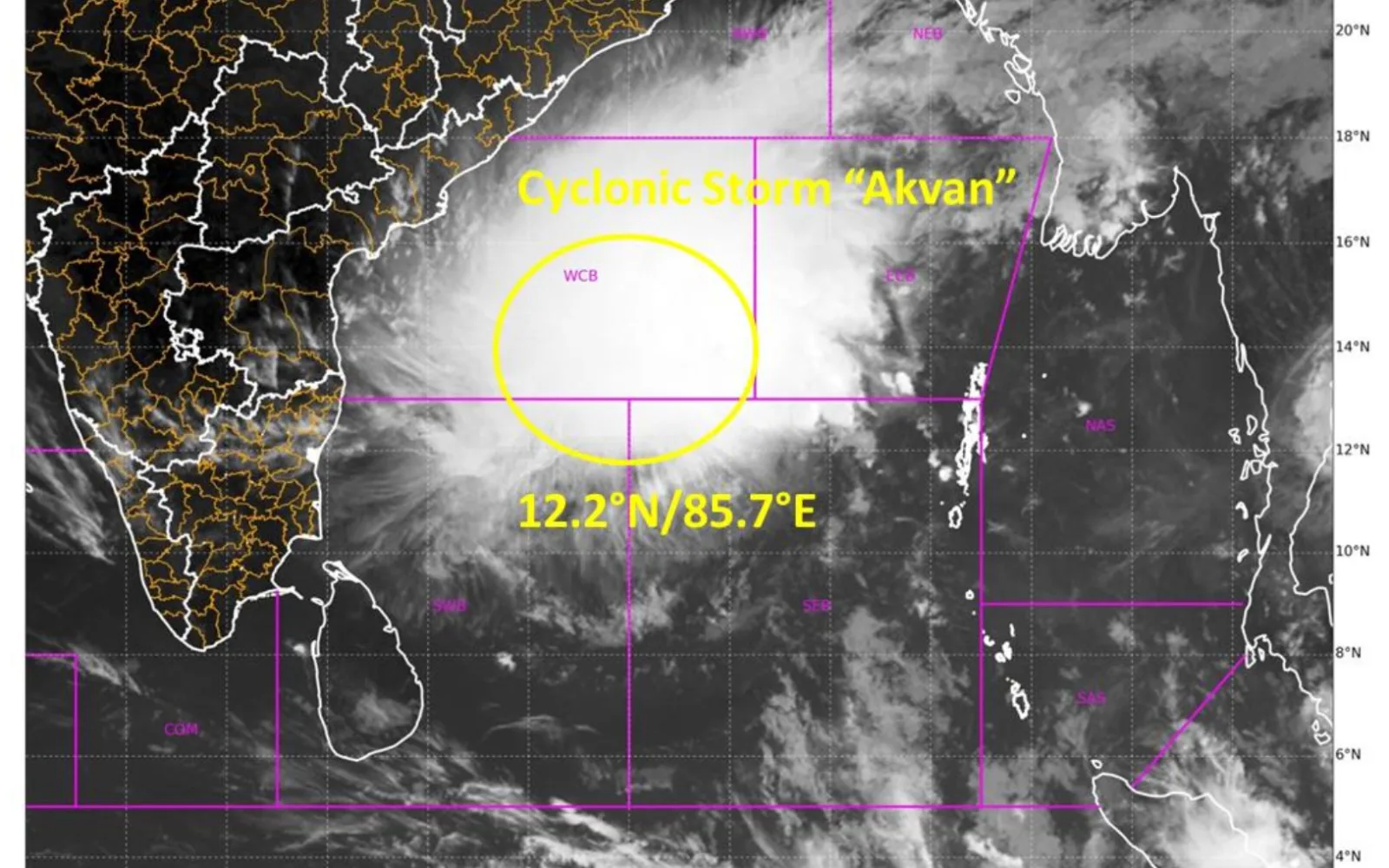
Cyclone Akvan crossed the Odisha and Andhra Pradesh coast near Gopalpur on the morning of 20 November 2026, ending a nervous week in which forecasters repeatedly redrew its path. It arrived weaker than feared, but it still forced the evacuation of more than 300,000 people and capped a rare run of three cyclones hitting the same coastline in less than a month.
What Akvan was
Akvan began as a low pressure area over the south Bay of Bengal on 12 November 2026. It strengthened into a depression on 15 November and into a cyclonic storm on 16 November, when the India Meteorological Department (IMD) gave it the name Akvan. It was the third cyclone of the 2026 North Indian Ocean season, after Very Severe Cyclonic Storm Arnab, which crossed near Narsapur on 28 October, and Severe Cyclonic Storm Murasu, which crossed near Ongole on 3 November.
The name came from Iran. Cyclones in the North Indian Ocean take their names in turn from a list of 169 names agreed by 13 countries under the World Meteorological Organization and UNESCAP panel. Akvan refers to Akvan Div, a demon-like character in the Persian epic Shahnameh, written by the poet Ferdowsi. In the story, Akvan takes the form of a wild ass and fights the hero Rostam.
A storm that kept changing its mind
Akvan was hard to forecast from the start. It was a poorly organised and asymmetric system, with its cloud mass displaced from its centre and its low level circulation partly exposed. On 17 November it stalled over the central Bay of Bengal for about 12 hours, barely moving, caught between two competing subtropical ridges that gave it almost no steering current.
Because of that erratic motion, the IMD kept shifting the forecast landfall zone northwards. The first outlook put it on the south-central Andhra Pradesh coast, between Nellore and Tuni. Later updates moved it to between Nellore and Visakhapatnam, then to between Narsapuram and Puri, and finally to the coastline between Visakhapatnam and Puri. On 18 November Akvan strengthened into a severe cyclonic storm, with maximum sustained winds of 100 to 110 kmph gusting to 120 kmph. At one stage the IMD forecast it could become a very severe cyclonic storm and cross the coast with winds of 120 to 130 kmph gusting to 145 kmph.
That did not happen. As Akvan neared the coast on 19 November it weakened, hit by wind shear, dry air intrusion and land interaction. By the time landfall began, it was back to an ordinary cyclonic storm.
Landfall and what happened next
Akvan crossed the north Andhra Pradesh and south Odisha coasts close to Gopalpur between 7:30 and 8:30 am IST on 20 November, with winds of 70 to 80 kmph gusting to 90 kmph. It then moved north-northeast across Odisha, weakening into a deep depression within three hours and into a depression within six more hours. By 11:30 pm it was a well marked low pressure area.
Rain was the bigger problem. The IMD warned of heavy to very heavy rain at a few places and isolated extremely heavy rain of 21 cm or more over Odisha on 20 November, with heavy rain alerts across 29 districts in south Odisha, north Andhra Pradesh, Jharkhand and West Bengal. Even after landfall the system kept affecting the weather: on 21 November the IMD forecast rain, thunderstorms, lightning and gusty winds of 30 to 40 kmph across several eastern and north-eastern states.
How the states prepared
Odisha, directly in the storm's path, put 74 National Disaster Response Force and Odisha Disaster Rapid Action Force teams on standby, backed by 131 fire service teams. More than 300,000 people were moved from vulnerable areas, including landslide prone hilly regions, to 9,341 cyclone shelters, supported by 2,523 relief camps. Schools and colleges in eight districts were closed for two to three days, fishing was banned, and 69 trains were cancelled.
In Andhra Pradesh, Chief Minister N. Chandrababu Naidu ordered response teams pre-positioned in vulnerable districts. State officials said 30,635 of the state's 30,808 registered fishing boats had returned to shore, and more than 108,250 voice alerts had been issued to fishing communities.
Why three cyclones in a month is rare
Three cyclones striking the same coastline within about a month is unusual. The IMD's Director of Meteorology described it as a very rare event. The post-monsoon season, from October to December, is the usual window for Bay of Bengal cyclones, but three landfalling systems in such quick succession, Arnab on 28 October, Murasu on 3 November and Akvan on 20 November, stretched the response system in both states. The lesson of Akvan is also a forecasting one: a weak, sheared and slow-moving storm can be harder to predict than a strong one, because small changes in steering decide where it goes and how strong it is when it gets there.
Frequently Asked Questions
Where did Cyclone Akvan make landfall?
Akvan crossed the north Andhra Pradesh and south Odisha coasts close to Gopalpur between 7:30 and 8:30 am IST on 20 November 2026, with winds of 70 to 80 kmph gusting to 90 kmph.
Why was Akvan weaker than forecast?
It ran into wind shear, dry air intrusion and land interaction as it neared the coast on 19 November. The IMD had forecast it could reach very severe cyclonic storm strength, with winds of 120 to 130 kmph, but it weakened to an ordinary cyclonic storm before landfall.
Who named Cyclone Akvan and what does the name mean?
The name was contributed by Iran under the regional naming system for the North Indian Ocean, which has a list of 169 names from 13 countries. Akvan refers to Akvan Div, a demon-like character in the Persian epic Shahnameh by Ferdowsi.
Read More: Explained: Maharashtra FDA vs FSSAI, the Food Safety Row
Read More: Explained: The CEC Law Row and the Supreme Court Recall Plea
Read More: Explained: Maharashtra SIR and the 14,567 Voter Deletion Requests
Read More: Explained: The Rs 874 Crore Plan to Clean the Yamuna



Comments
Be the first to comment on this story.