


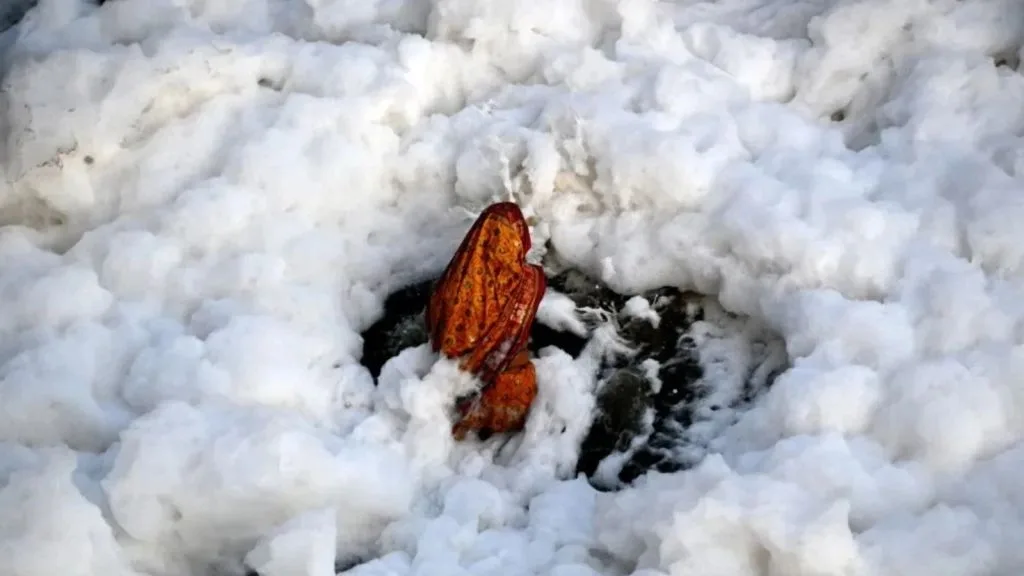
The Centre has approved two new sewage treatment plants in Delhi at a combined cost of Rs 874.49 crore, in the latest attempt to clean the most polluted stretch of the Yamuna. Together, the plants will treat 250 million litres of sewage a day, stopping untreated sewage from flowing into the river. The decision was taken by the empowered committee of the National Mission for Clean Ganga on 12 November.
The approval came days after photographs of devotees taking a dip in white foam-covered water during Chhath Puja put the river back in the headlines. The Yamuna has been the subject of cleanup promises for decades, and the new plan raises the same question every earlier plan has faced: will this one be enough?
What the Centre has approved
Two sewage treatment plants, or STPs, have been cleared. The larger one, with a capacity of 159 million litres per day (MLD), will be built at Rithala in north-west Delhi at an estimated cost of Rs 509.54 crore. The second, with a capacity of 91 MLD, will come up at the outfall of the Sen Nursing Home Drain near the Indraprastha Metro Station, at an estimated cost of Rs 362.95 crore.
Both projects will be funded under Namami Gange Mission-III and built through a hybrid annuity model based public-private partnership, under which the government pays part of the cost upfront and the rest as instalments linked to performance.
Why the Yamuna is so polluted
The Yamuna enters Delhi at Wazirabad and leaves at Okhla, a stretch of about 22 km. In that short run, it receives the bulk of the city's untreated or partly treated sewage, along with industrial waste. By the time it leaves the city, the river carries almost no dissolved oxygen, which is why it is often described as a dead stretch. The white foam seen during Chhath Puja is caused mainly by phosphates from detergents in untreated sewage, and it signals a high pollutant load in water that devotees bathe in.
The treatment gap in numbers
The core problem is a gap between how much sewage Delhi produces and how much it can treat. According to a Central Pollution Control Board report, Delhi generated 3,330 MLD of sewage as of March 2020, against an installed treatment capacity of 2,896 MLD. That leaves a shortfall of 434 MLD.
The gap is wider in practice than the installed figures suggest. Of the installed capacity, only 2,715 MLD across 35 plants was operational, and actual utilisation stood at 2,412 MLD. The two new plants, at 250 MLD combined, will cut that shortfall but will not close it on their own.
What else is happening
The new approvals sit inside a much larger clean-up push. In October 2026, Union Home Minister Amit Shah launched projects worth Rs 8,941 crore for Yamuna cleaning in Delhi, including a new 124 million gallons per day STP at Okhla, the upgrading of eight existing STPs, 29 decentralised sewage treatment plants, and 1,034 km of new sewer lines.
The Supreme Court is also watching the effort closely. On 17 November, a bench of Justices Manoj Misra and Manmohan reviewed a draft Yamuna Action Plan that envisages intercepting wastewater from 520 drains carrying about 9,666.81 MLD into the Yamuna and its tributaries, along with 125 new sewage treatment plants and 12 common effluent treatment plants. The court has directed existing plants to install tamper-proof meters with live monitoring, and the case is listed for further hearing on 13 January 2027.
Cleaning the Yamuna was also a central promise of the BJP's manifesto for the 2025 Delhi Assembly elections. After the BJP came to power in Delhi last year, Amit Shah held a series of review meetings on Yamuna rejuvenation with Union Jal Shakti Minister C R Patil, Housing and Urban Affairs Minister Manohar Lal Khattar and Delhi Chief Minister Rekha Gupta.
Will it be enough
On paper, the two new plants are a clear step forward. They add 250 MLD of treatment capacity at two points where untreated sewage now enters the river, and the hybrid annuity model ties the private operator's payments to performance.
But the numbers show the limits of the plan. Even after these plants are built, Delhi will still face a treatment shortfall, and the river's health depends on much more than capacity: on whether drains are intercepted before they reach the river, whether existing plants run at full capacity, and whether industrial waste is kept out. The Supreme Court's demand for live monitoring reflects the same concern, that treatment capacity on paper and treated water in the river are two different things. The Yamuna will be judged not by the money cleared, but by what flows out of the new plants and into the river.
Frequently Asked Questions
How much will the two new Yamuna sewage treatment plants cost?
The two plants will cost an estimated Rs 874.49 crore in total. The 159 MLD plant at Rithala will cost Rs 509.54 crore, and the 91 MLD plant at the Sen Nursing Home Drain outfall will cost Rs 362.95 crore.
What is the sewage treatment gap in Delhi?
Delhi generated 3,330 MLD of sewage as of March 2020, against an installed treatment capacity of 2,896 MLD, a shortfall of 434 MLD. Actual utilisation was lower still, at 2,412 MLD across 35 operational plants.
Why does white foam appear on the Yamuna?
The foam is caused mainly by phosphates from detergents in untreated sewage flowing into the river. It appears most visibly during Chhath Puja, when devotees enter the water, and it signals a high pollutant load in the river.
Read More: Explained: Why India's Oil Import Bill Rose 54% in Seven Months
Read More: Explained: Why Gold Prices Have Fallen 25% in Nine Months
Read More: Explained: Why India's Core Sector Growth Hit a Series-High 10.9%
Read More: Explained: Why the AI Sell-Off Wiped Out Wall Street's 2026 Gains

Comments
Be the first to comment on this story.