


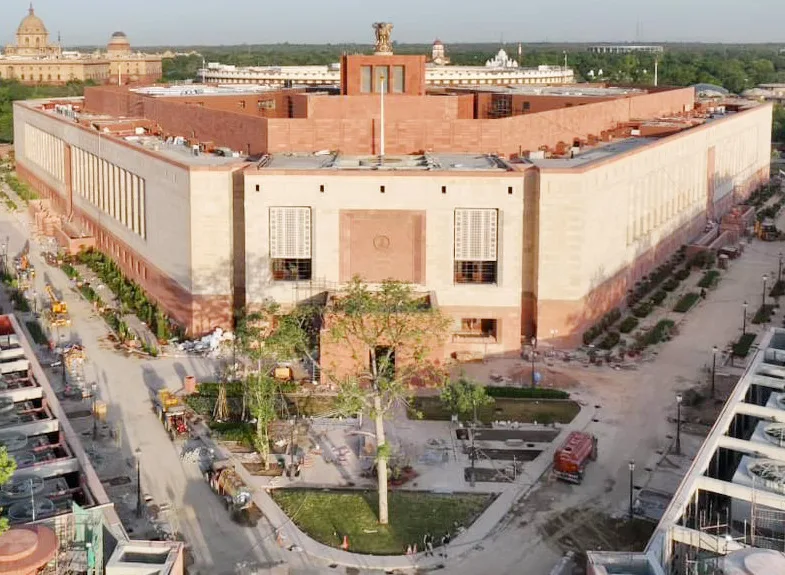
The Lok Sabha has had 543 elected seats for half a century, frozen in place by a decision taken in 1976. That freeze ends after the 2026 Census, and the fight over what replaces it has become one of the sharpest political rows of the Winter Session.
What delimitation is
Delimitation is the process of redrawing the boundaries of parliamentary and assembly constituencies so that each elected representative speaks for a roughly equal number of people. Article 82 of the Constitution provides for the readjustment of Lok Sabha seats and constituency boundaries after every Census, and Article 170 does the same for state assemblies. Article 81 lays down the framework for allocating seats among the states, on the principle that the ratio of seats to population should be broadly uniform across states. As populations grow at different rates, seats are meant to move with them.
Why the House has been frozen at 543
The freeze was a deliberate policy choice. The 42nd Constitutional Amendment Act of 1976 froze the allocation of Lok Sabha seats on the basis of the 1971 Census, so that states which controlled their population growth would not lose parliamentary representation as a consequence. The 84th Amendment Act of 2001 extended that freeze until the figures from the first Census after 2026 are published. The current constitutional framework caps the Lok Sabha at 550 elected members, up to 530 from states and 20 from Union Territories. The Census of 2026-27 is already underway, which is why the question can no longer be put off.
What the government proposed in April 2026
In April 2026 the government introduced a three-Bill package: the Constitution (131st Amendment) Bill, 2026, the Union Territories Laws (Amendment) Bill, 2026, and the Delimitation Bill, 2026. Together they proposed raising the Lok Sabha ceiling from 543 to 850 seats, up to 815 from states and 35 from Union Territories, expanding every state's seats by a uniform 50 percent, basing the exercise on the 2011 Census, and activating 33 percent reservation for women through the Nari Shakti Vandan Adhiniyam from the 2029 elections. Under a uniform 50 percent rise, Uttar Pradesh would go from 80 seats to 120 and Tamil Nadu from 39 to 59.
The package did not survive. The constitutional amendment needed a two-thirds majority of members present and voting. On 17 April 2026 it received 298 votes in favour and 230 against, short of the 352 required. With the amendment negatived, the Delimitation Bill and the Union Territories Bill, which depended on it, could not proceed, and the government withdrew the Delimitation Bill. It was the first time a constitutional amendment brought by the Modi government had failed in the Lok Sabha.
Why southern states object
The objection is about population growth. The five southern states accounted for about 25 percent of India's population in 1971, but only about 21 percent in 2011, while northern states such as Uttar Pradesh and Bihar grew much faster. Congress leader P Chidambaram has estimated that if seats were redistributed purely on current population, the southern states would fall from 129 seats to 103, losing 26, while large northern states gained heavily. Tamil Nadu Chief Minister M K Stalin has argued that the exercise would punish states that successfully implemented family planning. The opposition also asked why the government was rushing ahead on 2011 Census data when the 2026-27 Census is already underway.
The government rejects that reading. Home Minister Amit Shah told the Lok Sabha that the southern states would gain seats, not lose them, rising from 129 to 195 in an expanded House of 816, still roughly 24 percent of the total. Kerala, for example, would rise from 20 seats to 30. Critics respond that a uniform 50 percent rise ignores the demographic change since 1971 and sits uneasily with Article 81's population principle.
What the Congress now proposes
On 20 November 2026 the Congress set out its own position, saying the INDIA bloc was on board. Congress general secretary Jairam Ramesh proposed a four-point formula: retaining the existing strength of 543 seats in the Lok Sabha; maintaining the present state-wise distribution of seats; reserving one-third, or 182, of the existing seats for women; and imposing a 25-year freeze on all three arrangements. The party said it wanted the delimitation issue resolved through dialogue with all political parties, but accused the government of making no effort to engage the opposition. A Winter Session showdown over the issue is now expected.
What happens next
Nothing changes until the Census figures are published. The freeze lifts only when the first Census after 2026 is published, and any new delimitation will need a Delimitation Commission constituted by Parliament. Expanding the House beyond 550 seats would still need a constitutional amendment passed by a two-thirds majority, which the April vote showed the government does not currently command. Until a new settlement is reached, the Lok Sabha stays at 543 seats.
Frequently Asked Questions
What is delimitation?
Delimitation is the redrawing of constituency boundaries and the reallocation of seats after each Census, so that representation in Parliament and state assemblies keeps pace with changes in population.
Why has the Lok Sabha stayed at 543 seats since 1976?
The 42nd Amendment froze seat allocation on 1971 Census figures to reward states that controlled population growth. The 84th Amendment extended the freeze until the first Census after 2026 is published.
What did the Delimitation Bill 2026 propose?
It proposed a uniform 50 percent expansion of Lok Sabha seats to a ceiling of 850, based on the 2011 Census, along with 33 percent reservation for women from 2029. Its constitutional amendment was voted down on 17 April 2026, and the Bill was withdrawn.
Read More: Explained: The CEC Law Row and the Supreme Court Recall Plea
Read More: Explained: Maharashtra SIR and the 14,567 Voter Deletion Requests
Read More: Explained: The Rs 874 Crore Plan to Clean the Yamuna
Read More: Explained: How NSE Became the World's Fifth Largest Listed Exchange


Comments
Be the first to comment on this story.