


Lightning never strikes the same place twice. It is one of the oldest sayings in the English language, offered as comfort after a disaster and repeated so often that most people treat it as fact. The verdict is clear: it is a myth. Lightning strikes the same place again and again, and some places are hit dozens of times every year. The United States National Weather Service lists the saying as a myth, and the numbers behind that verdict are hard to argue with.
The buildings that prove it
The most famous proof stands in the middle of New York City. The Empire State Building is struck by lightning about 25 times a year, according to the building's own figure, while the National Weather Service puts the average at 23 strikes a year. During one severe thunderstorm, instruments recorded eight separate strikes hitting the building's spire in just 24 minutes. That is the same place, struck eight times, before half an hour had passed.
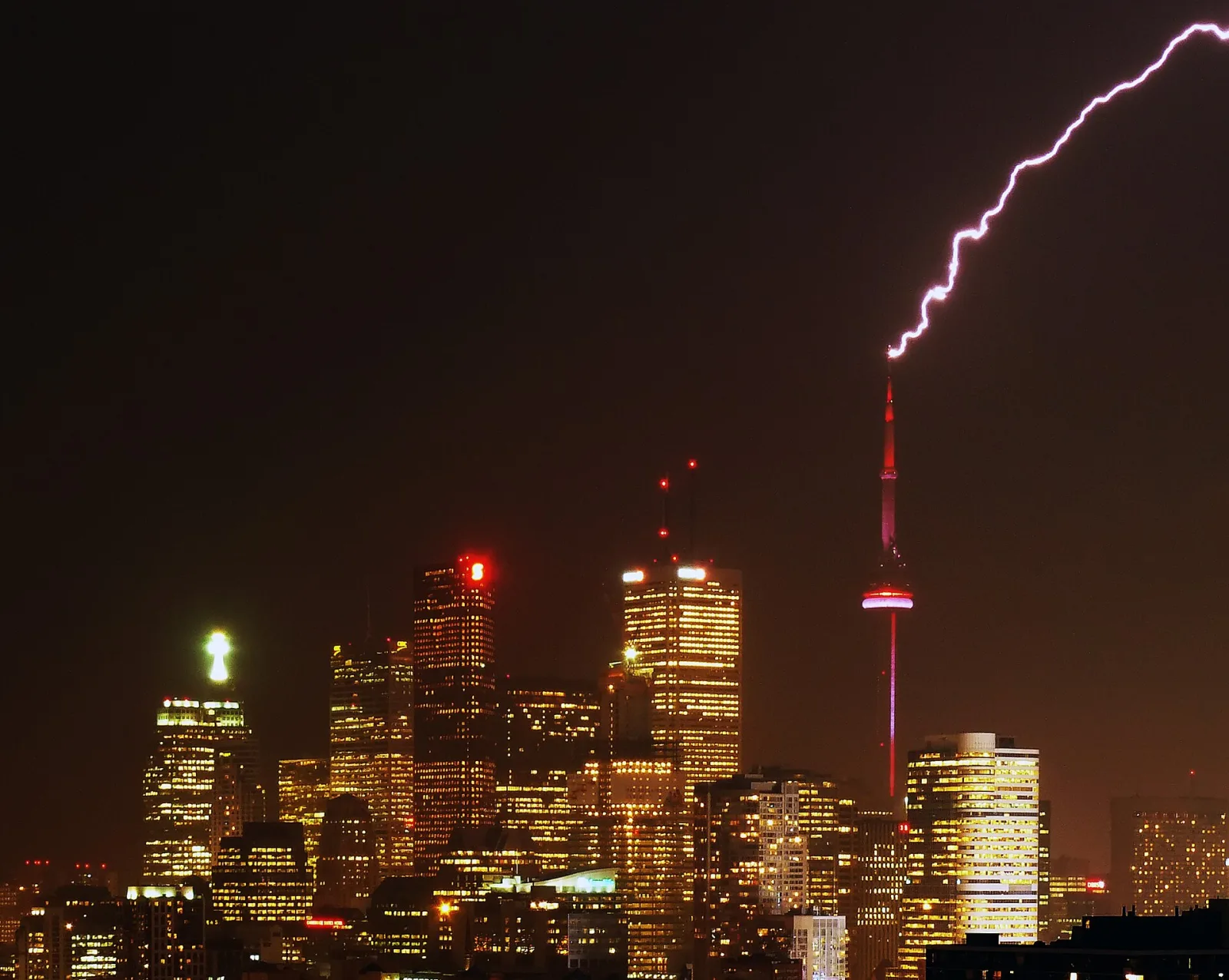
Toronto's CN Tower is struck even more often. The tower is 553 metres tall, a concrete shaft topped by a 100 metre steel antenna mast, with copper strips running its full height into grounding rods sunk beneath its base. Its operators say it takes about 75 strikes a year. Researchers who counted flashes optically over many seasons put the long run average closer to 36 a year, but either number destroys the myth. On the night of 24 August 2011, cameras recorded 52 flashes hitting the tower in a little over 84 minutes, roughly one strike every 99 seconds.
Other tall structures tell the same story. The Santis tower on a mountain top in Switzerland is struck about 100 times a year. Tokyo Skytree, at 634 metres, reports around 10 strikes a year and is used as a giant lightning laboratory, with equipment mounted high on the structure to measure the current of each strike directly. These buildings are not struck in spite of their lightning rods. They are struck because they are tall, pointed and isolated, and their rods are bolted into the ground precisely because engineers know the sky will be back.
One flash can strike the same spot many times
The myth fails even inside a single bolt of lightning. What we call one flash is usually several discharges running down the same ionised channel, a few hundredths of a second apart. That is why lightning flickers instead of flashing once. The National Oceanic and Atmospheric Administration's National Severe Storms Laboratory notes that a single negative cloud to ground flash can contain as many as 20 return strokes. By the plain meaning of the words, one strike has already hit the same spot many times before the thunder arrives.
The man struck seven times
Buildings are not the only repeat targets. Roy Sullivan was a park ranger in Shenandoah National Park in Virginia, and between 1942 and 1977 lightning found him seven separate times. He was struck on a fire tower, in his truck, on foot patrol and while fishing, and he survived all seven strikes. Sullivan's case is extreme, and it is also a warning: lightning does not keep a list of places it has already visited, and it has no memory of where it has been. It follows the path of least resistance, and if the same conditions repeat, it will take the same path again.
Why the saying survives
The saying has been in print since at least the 1830s, and it survives because it does a job that has nothing to do with weather. It is something one person says to another after something terrible, an offer of odds that nobody has checked. It sounds comforting, and it makes danger feel as if it moves on.
There is also a grain of truth hiding inside it. Any one patch of ordinary open ground is rarely struck at all, let alone twice. Lightning is drawn to tall, pointed, isolated objects, so a flat field or an empty stretch of road may never be hit in a lifetime. The mistake is turning that observation about open ground into a rule about everywhere. The same physics that leaves a field alone is what brings lightning back to the same tower, the same tree on a hill and the same mountain peak, storm after storm.
The verdict
Lightning does strike the same place twice. Tall towers are hit dozens of times a year, one flash can strike the same channel many times in under a second, and one unlucky ranger was struck seven times. The old saying is a piece of comfort, not a fact of nature.
The practical lesson is the opposite of the saying. A place that has been struck before is a place that can be struck again, so it is no safer than anywhere else. The National Weather Service advises that when thunder roars, you should go indoors, and you should stay inside for 30 minutes after the last thunder is heard. If you can hear thunder, you are close enough to be struck.
Frequently Asked Questions
Does lightning ever strike the same place twice?
Yes, often. The Empire State Building is struck about 25 times a year, the CN Tower dozens of times a year, and the Santis tower in Switzerland about 100 times a year. The National Weather Service lists the saying as a myth.
Can one lightning flash strike the same spot more than once?
Yes. A single flash usually contains several return strokes down the same channel, a few hundredths of a second apart, which is why lightning flickers. A flash can contain as many as 20 return strokes.
Who was struck by lightning the most times?
Roy Sullivan, a park ranger in Shenandoah National Park in Virginia, was struck seven times between 1942 and 1977 and survived all seven strikes.
Read More: Myths and Facts: Vitamin C Does Not Prevent the Common Cold
Read More: Chewing Gum Myth: Swallowed Gum Does Not Stay 7 Years
Read More: Experts Say You Do Not Lose Most Body Heat Through Your Head
Read More: Eating Carrots Will Not Give You Superhuman Night Vision


Comments
Be the first to comment on this story.