


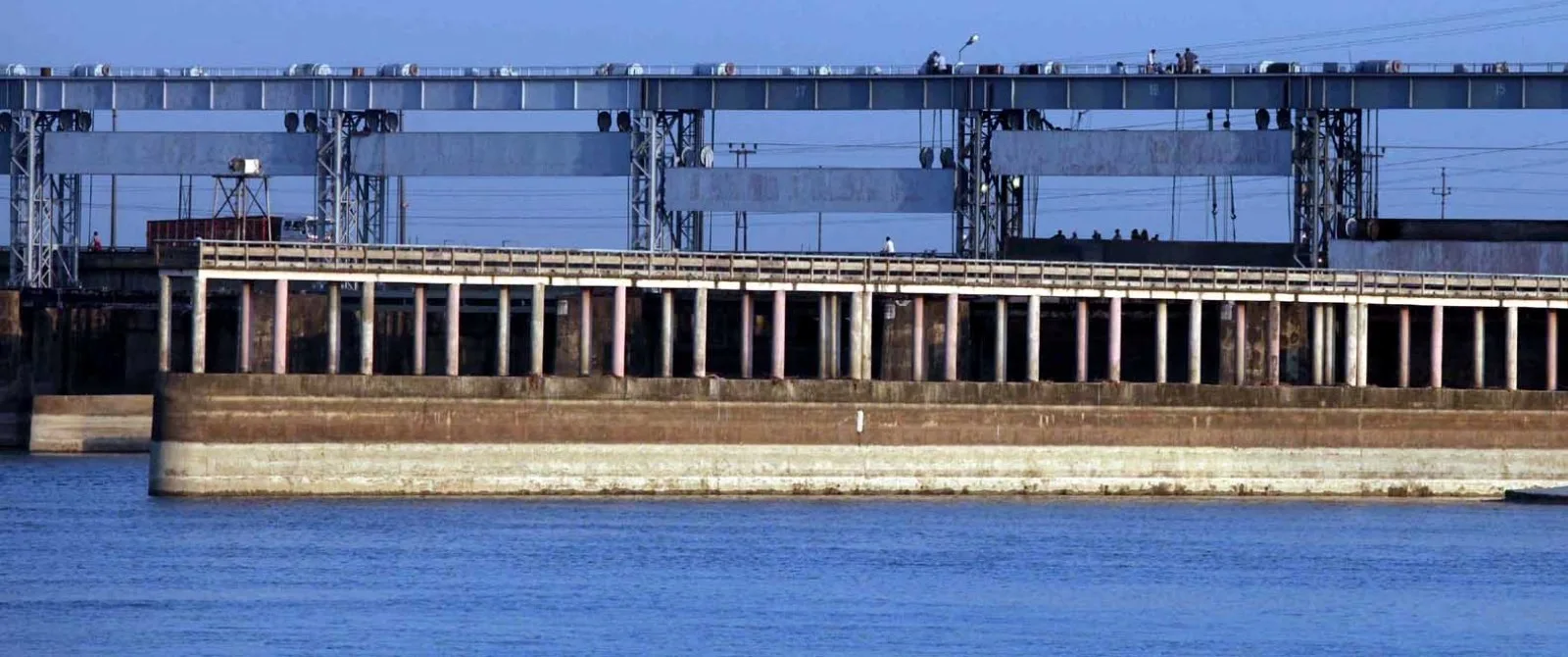
The 1996 Ganga Water Sharing Treaty between India and Bangladesh lapses on December 12, less than three weeks from now. Officials from both countries met in Dhaka over the weekend, but there is still no official word on whether the pact will be renewed, and on what terms.
How the treaty came about
Tensions over sharing the Ganga go back to the 1950s, when India proposed a barrage at Farakka in West Bengal, about 18 km from what would become the border with East Pakistan. Construction began in 1961 and finished in 1975. The barrage diverts Ganga water into the Hooghly river to flush silt around the Kolkata port and keep it navigable.
Friction ran through the project. In 1976, Maulana Bhashani, an Awami League legislator in newly independent Bangladesh, led the Farakka Long March against India's water policies, arguing the barrage had dried up the Padma, the Ganga's main distributary in Bangladesh, and caused desertification. Ad hoc agreements followed in 1977, 1982 and 1985, but none lasted. Finally, in December 1996, Prime Ministers H D Deve Gowda and Sheikh Hasina signed the Ganga Water Sharing Treaty, a 30-year framework for sharing flows in the dry season, from January to May, with a joint committee to monitor it.
What the treaty says
The treaty sets a three-tier sharing formula based on average flows recorded over 10-day periods between 1949 and 1988. If the flow at Farakka falls to 70,000 cusecs or below, the two countries share the water equally. If it is between 70,000 and 75,000 cusecs, Bangladesh gets 35,000 cusecs and India keeps the rest. If it is 75,000 cusecs or more, India gets 40,000 cusecs and Bangladesh receives the balance.
There is an extra guarantee for the leanest weeks. Between March 11 and May 10 each year, both countries receive a guaranteed 35,000 cusecs in alternate three 10-day periods. The treaty has no minimum guarantee clause, but Article II(iii) says that if the flow at Farakka falls below 50,000 cusecs in any 10-day period, the two governments will enter into immediate consultations to make adjustments on an emergency basis, guided by equity, fair play and no harm to either party.
Disputes go first to the Joint Committee, with equal representatives from both governments. If that fails, they go to the Joint Rivers Commission, set up in 1972 to manage water sharing across 54 shared rivers. The Ganga is the only one of those rivers governed by a formal treaty.
Where renewal talks stand
The treaty allows renewal by mutual consent at the end of its 30-year term, and both sides have said they are willing to revisit its terms. Representatives met in Dhaka on November 21 and 22 for the 91st routine meeting of the India-Bangladesh Joint Committee, but there was no official word on whether renewal was discussed. Reports have indicated that Bangladesh appears agreeable to renewing the pact rather than seeking a fresh agreement.
The sticking points are well known. Reports from last year said India was seeking an additional 30,000 to 35,000 cusecs during the March 11 to May 10 period to meet its growing needs, and that a new treaty could run for a shorter period of 10 to 15 years. Bangladesh, for its part, has asked for a guaranteed release of 40,000 cusecs between February and May, a longer renewal period and better flood data sharing.
Bangladesh has also pressed for a minimum guarantee to be written back into the pact, similar to the 1977 ad hoc agreement, which guaranteed Bangladesh at least 80 percent of its scheduled allocation in certain lean-season periods even when actual availability fell short. Nilanjan Ghosh, who heads Development Studies at the Observer Research Foundation, has argued that a fixed volumetric guarantee binding regardless of actual flows would put an asymmetric burden of hydrological risk on the upstream country, and that India cannot commit to such a demand.
The politics around the treaty
Politics on both sides complicate the talks. After the Tarique Rahman-led Bangladesh Nationalist Party won a landslide in the February 2026 general election, reports said renewing the treaty would be among the new government's top priorities. But no discussions have followed, even as tensions continue over the extradition of former prime minister Sheikh Hasina, who has lived in exile in New Delhi since her ouster in August 2024. It was understood to be why Rahman did not go ahead with a proposed official visit in August 2026, which would have been his first since becoming prime minister.
In August, resistance also surfaced in Bihar, where the Janata Dal (United), an ally of the BJP, pushed against renewal, saying the pact had proved detrimental to Bihar's interest. Bangladesh is also watching India's decision last year to put the 1960 Indus Waters Treaty with Pakistan in abeyance after the Pahalgam terror attack in April 2025, a step that has prompted caution in Dhaka.
What happens next
Srinivas Chokkakula, president and chief executive of the Centre for Policy Research, wrote in a July 2026 article that the next treaty presents an opportunity not merely to renew a bilateral water sharing arrangement but to reimagine a regional strategic vision for shared vulnerabilities. He argued that the two countries will need to invest in better processes and revisit their bilateral institutions, and rebuild the political capital that made the 1996 treaty possible.
With the December 12 deadline approaching, the question is whether the two governments can agree on new terms in time, or whether the pact lapses and the two sides fall back on ad hoc arrangements while talks continue.
Frequently Asked Questions
When does the Ganga Water Treaty lapse?
The 1996 treaty lapses on December 12, 2026, thirty years after it was signed by Prime Ministers H D Deve Gowda and Sheikh Hasina.
How does the treaty share the Ganga's water?
It uses a three-tier formula based on flows at Farakka. At 70,000 cusecs or below, the water is shared equally. Between 70,000 and 75,000 cusecs, Bangladesh gets 35,000 cusecs. At 75,000 cusecs or more, India gets 40,000 cusecs and Bangladesh gets the balance.
What is the main sticking point in renewal talks?
Bangladesh wants a minimum guarantee of water in lean-season periods written back into the pact, while India has resisted a fixed volumetric guarantee that would apply regardless of actual river flows.
Read More: Explained: G20 Johannesburg Summit, Six Proposals by Modi
Read More: Explained: Pax Silica, the AI Pact India Just Signed
Read More: Explained: Why the Shenzhen Nuclear Declaration Matters
Read More: Explained: Why COP31 Ended Without a Deal on Fossil Fuels
Comments
Be the first to comment on this story.