


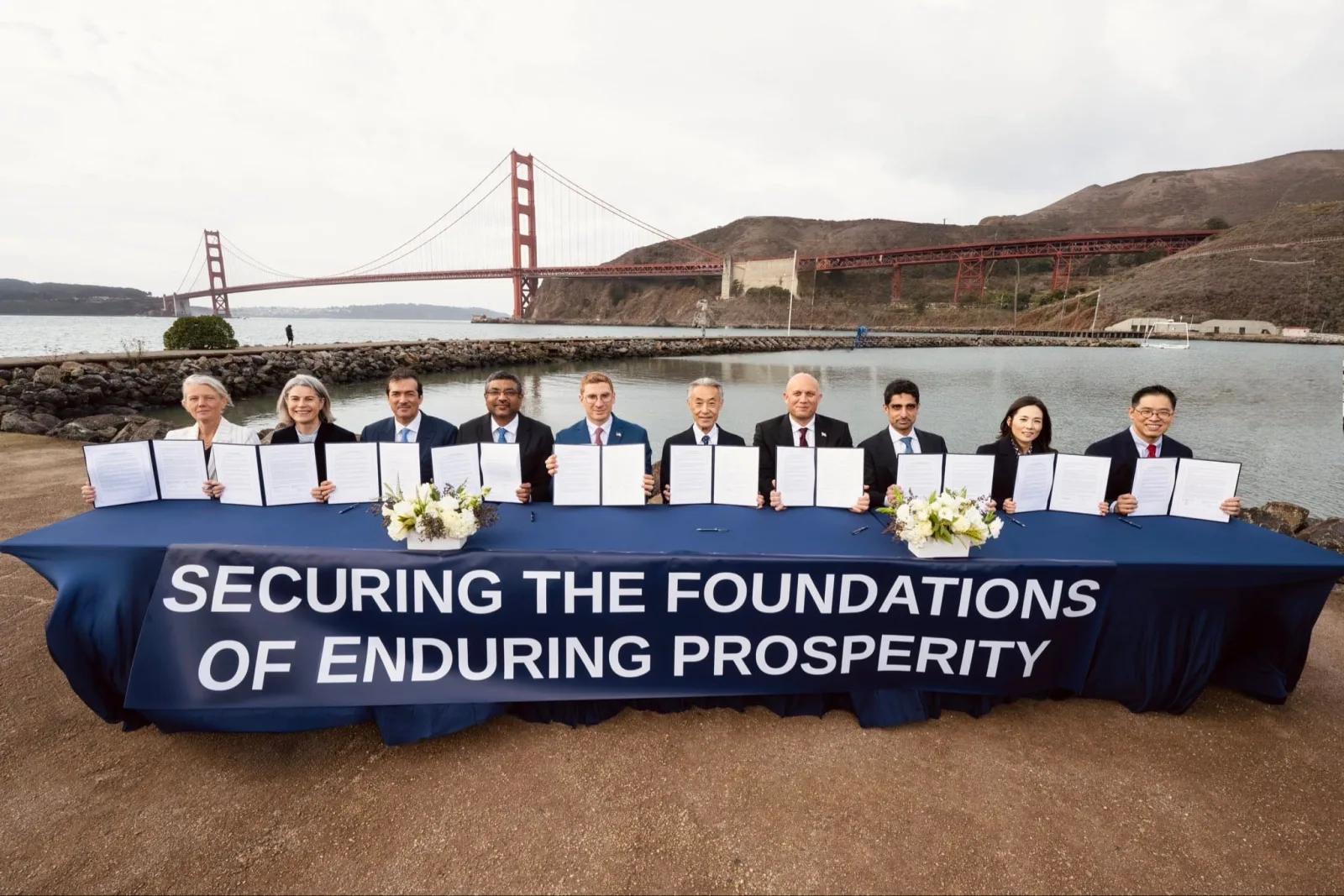
India has joined a US-led pact to protect the supply chains behind advanced artificial intelligence. On November 15, 2026, India signed the San Francisco Declaration on the Secure Foundations of Enduring Prosperity at the Pax Silica Founders Retreat in San Francisco, alongside the United States and eight other governments. The pact treats the hardware, materials and infrastructure behind AI as shared national assets that partner countries must protect together.
What is Pax Silica
Pax Silica is a US State Department initiative launched in December 2025 by Under Secretary of State for Economic Affairs Jacob Helberg. It is the department's flagship effort on AI and supply chain security. The initiative was built around a simple idea: the race for advanced AI is no longer only about software and algorithms. It is about who controls semiconductor manufacturing, rare earth processing, specialised equipment, data centres and the energy systems that keep them running.
India formally joined Pax Silica at the India AI Impact Summit in New Delhi on February 20, 2026. S Krishnan, Secretary of the Ministry of Electronics and Information Technology, signed India's initial agreement in the presence of Union Minister Ashwini Vaishnaw. The San Francisco Declaration extends that cooperation into a shared statement of intent among ten governments.
Who signed the declaration
The declaration was signed by the United States, India, Australia, Israel, Japan, South Korea, Qatar, Singapore, the United Arab Emirates and the United Kingdom. Krishnan led the Indian delegation and signed for India. The meeting was convened by Helberg, who said the partners had agreed to treat the security of AI technologies and the infrastructure behind them as a shared responsibility.
The US State Department has said India brings to Pax Silica a deep talent pool, processing and refining capacity for critical minerals, investment in AI infrastructure and an understanding of the importance of trusted technologies. The declaration has since drawn wider interest, with more governments, including Germany, Sweden, the Netherlands and the European Commission, expected to join.
What the pact seeks to protect
The declaration sets out two broad categories of assets that the signatories say need protection. The first is sensitive technologies: the software, materials, technical knowledge, components, manufacturing inputs and production capabilities essential to what the partners call the Super Intelligence era. The signatories say the theft, illicit transfer or acquisition of such technologies by hostile actors could hand over a military or intelligence advantage, or create undue economic leverage.
The second category is critical infrastructure: the physical and digital systems underpinning AI supply chains. That includes ports, terminals, transport and logistics networks, communications systems, energy infrastructure and the digital platforms used to coordinate supply chains. The declaration says the security of each partner is strengthened by the vigilance of all.
The five working groups
The declaration is a political commitment, not a binding treaty. It does not immediately create procurement requirements, technology transfer obligations or new Indian regulations. Instead, the partners have committed to setting up five working groups to turn the shared commitments into coordinated action over the next six months.
The five areas are pro-innovation policy frameworks, adoption of Super Intelligence across key economic sectors, supply chain cooperation across the technology stack, safe harbours and supply chain security hubs, and Super Intelligence security and resilience. The groups are meant to deliver concrete results, including stronger protection of sensitive technologies and closer cooperation in enforcing national policies against undue access to, or control over, such assets.
Why it matters now
The signing came on a day of tightening controls. On November 16, the US government tightened export and re-export rules for advanced AI chips to five countries, Singapore, Indonesia, Brazil, Malaysia and Thailand, requiring exporters to obtain licences amid concerns over the possible diversion of sensitive semiconductor technology. The declaration also lands amid intensifying rivalry with China, with Washington seeking to counter Beijing's growing influence in strategic sectors.
For India, the most important challenge is dependence on foreign suppliers, particularly China, across semiconductors, critical minerals and advanced manufacturing. The declaration's emphasis on diversified and trusted supply chains speaks directly to that dependence. It does not solve it, but it gives India a seat at a table where the rules for protecting those supply chains are being written.
Market watchers have welcomed the move, but they caution that a declaration is only a starting point. Its value will depend on whether the working groups produce real cooperation on manufacturing capacity, secure supply chains and shared standards, rather than statements alone.
What it means for India
For India, the pact is both a recognition and a test. Recognition, because its talent, mineral processing capacity and AI infrastructure investment are seen as assets worth protecting. A test, because the commitments will only matter if they translate into manufacturing capacity and secure supply chains at home. The declaration does not change any Indian law or regulation today, but it signals that New Delhi intends to be part of the trusted circle shaping how AI is built, supplied and protected.
Frequently Asked Questions
What is Pax Silica?
Pax Silica is a US-led initiative launched in December 2025 to secure the global supply chains behind advanced AI, covering semiconductors, critical minerals, energy inputs and AI infrastructure. India joined it in February 2026.
What did India sign in San Francisco?
India signed the San Francisco Declaration on the Secure Foundations of Enduring Prosperity on November 15, 2026, along with nine other governments. It is a political commitment to protect the sensitive technologies and critical infrastructure behind AI supply chains.
Is the declaration binding on India?
No. It creates no immediate procurement requirements, technology transfer obligations or new Indian regulations. Its value depends on the five working groups turning the shared commitments into practical cooperation.
Read More: Explained: Why the Shenzhen Nuclear Declaration Matters
Read More: Explained: Why COP31 Ended Without a Deal on Fossil Fuels
Read More: Explained: Labour Codes One Year On, What Has Changed for Workers
Read More: Explained: Why India's Core Sector Growth Hit a Series-High 10.9%


Comments
Be the first to comment on this story.