


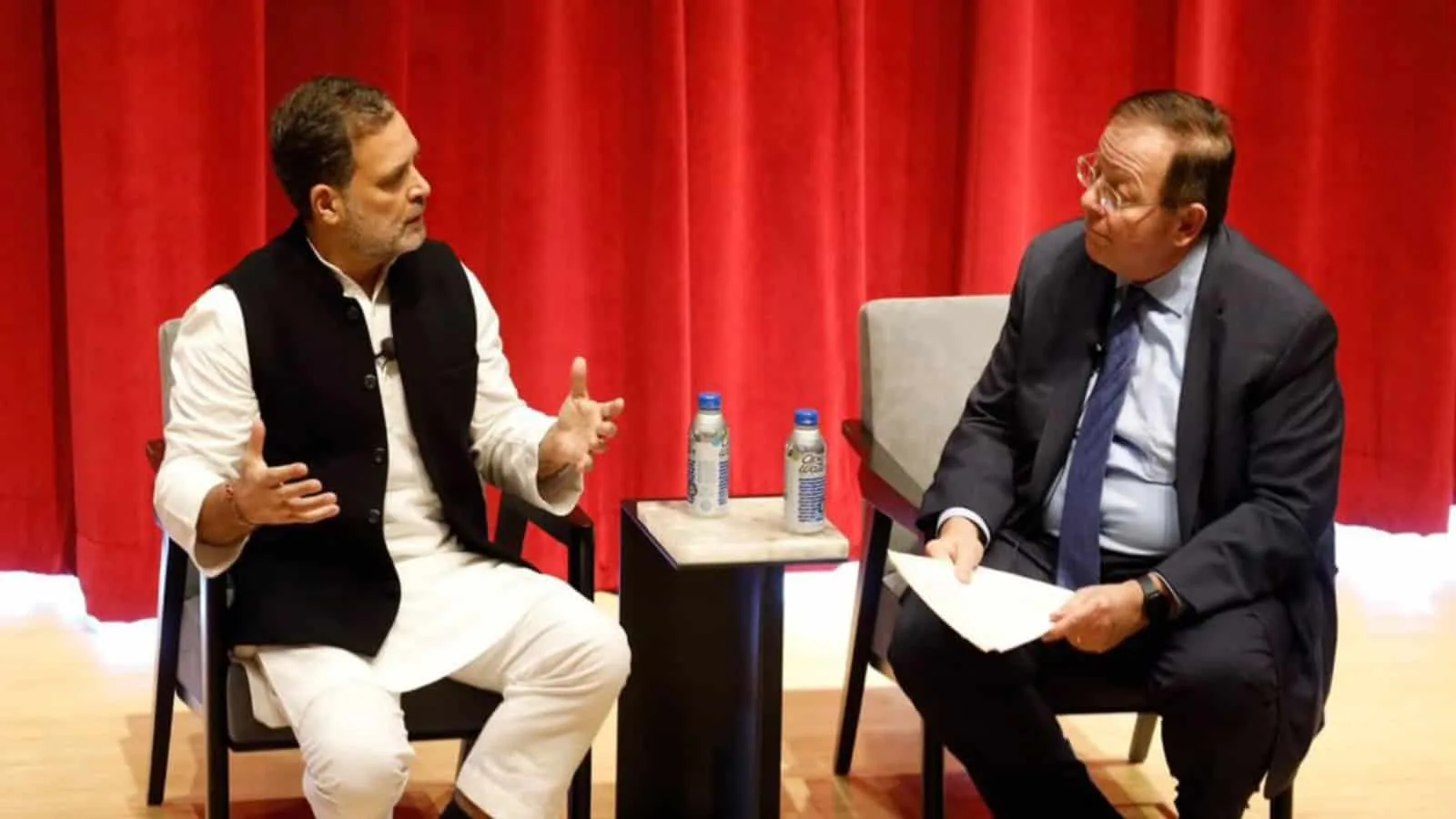
Congress leader Rahul Gandhi has said India should maintain a strong relationship with Israel for strategic reasons, while refusing to stay silent on Gaza. Speaking at the University of Chicago on 18 November 2026, he condemned both the Hamas attacks of 7 October 2023 and Israel's actions in Gaza, saying one wrong cannot justify another. His remarks have reopened a debate about how India balances its ties with Israel and its long support for the Palestinian cause.
What Rahul Gandhi said
Gandhi was speaking at the University of Chicago during an interaction with political scientist Professor Robert Pape, titled "The Iran War and India's Role in the World". It came during a two-day visit to the United States, during which he also addressed students at Columbia University.
"India's foreign policy must be guided by what is good for India," Gandhi said in a post on X on 19 November, sharing a clip of the discussion. "I support a strong relationship with Israel. We have strategic interests, including buying the best weapons for our armed forces. But that cannot mean silence on Gaza."
He added: "I condemn the October 7th attacks and the killing of innocent people. I also condemn what Israel has done in Gaza. One wrong cannot justify another."
Gandhi also said India had become a "side player" in global affairs, and that no country, whether Israel, the United States, Russia or China, should hold India back from playing its rightful role on the world stage.
Where India stood on Israel and Palestine historically
India recognised the State of Israel soon after it was created in 1948, but full diplomatic relations took more than four decades to arrive. As The Indian Express explained, leaders such as Jawaharlal Nehru and Mahatma Gandhi opposed the creation of a state based on religion, a view in line with their opposition to the Partition of India. India's position on Palestine was also guided by the consensus in the Arab world, the Non-Aligned Movement and the United Nations.
On 10 January 1975, India recognised the Palestine Liberation Organisation (PLO) as the sole and legitimate representative of the Palestinian people and allowed it an independent office in New Delhi.
That stance held even under the first non-Congress government at the Centre. Addressing a public meeting in January 1978, then External Affairs Minister Atal Bihari Vajpayee asked the Non-Aligned Movement and all those who believed in peace and justice to "raise their voice in protest against the injustice being meted out to Palestinians".
How the relationship with Israel changed
Over time, several factors shifted India's approach. The Cold War ended, Arab countries showed a willingness to negotiate peace, and India had already obtained arms from Israel during the 1962 war with China and the wars with Pakistan in 1965 and 1971, which pointed to a sense of "shared security".
After his 1984 election victory, Prime Minister Rajiv Gandhi began contacts with Israel. Those contacts became part of the pragmatic, non-ideological foreign policy pursued by P V Narasimha Rao.
The turning point came in the early 1990s. Iraq's invasion of Kuwait in 1990 cost the PLO political leverage because of its support for Saddam Hussein, and the Soviet Union disintegrated around the same time. India moved to change its West Asia policy.
Palestinian President Yasser Arafat visited India on 19 and 20 January 1992. In a meeting with Prime Minister Rao, he was told that establishing ties with Israel would help the Palestinian cause, because New Delhi could influence Israel only if it had an ambassador in Tel Aviv. Arafat agreed, telling a press conference in New Delhi that the exchange of ambassadors and recognition of Israel were acts of sovereignty in which he could not interfere. India formally established diplomatic ties with Israel on 29 January 1992, about ten days after Arafat's public approval.
The defence factor
By the Kargil war in 1999, full diplomatic ties proved their worth. The Indian Air Force needed precision bombs to target Pakistani intruders hiding in caves and bunkers in the Kargil mountains. After political approvals, Indian officials reached out to their Israeli counterparts, who dug into emergency stockpiles and shipped the bombs to Indian air bases within days.
Then President Pranab Mukherjee acknowledged the support during a 2015 visit to Israel, thanking it for providing "critical defence supplies". India followed up with high-profile visits in 2000, with External Affairs Minister Jaswant Singh leading the first ever Indian bilateral visit and Home Minister L K Advani visiting the same summer.
Defence trade has only grown since. India has been the biggest purchaser of Israeli weapons over the last decade, especially between 2015 and 2019, buying drones, missile systems, sensors, surveillance technology and border-control equipment.
Why the remarks matter now
Gandhi's comments differ from the stronger, more critical stance adopted by key members of the Congress party so far, and they drew criticism from Left parties. CPI(ML) Liberation general secretary Dipankar Bhattacharya said India could not have an independent foreign policy while advocating strong strategic ties with Israel.
At the same time, The Print noted that Gandhi's position closely resembles the Modi government's approach, which has maintained strong ties with Israel while consistently backing a two-state solution to the Israel-Palestine conflict.
The episode shows how the balance India struck in 1992 still shapes its politics today: close defence and strategic ties with Israel on one side, and a stated commitment to the Palestinian cause on the other. Gandhi's argument is that the first should not silence India on the second.
Frequently Asked Questions
What did Rahul Gandhi say about Israel and Gaza?
At the University of Chicago on 18 November 2026, Gandhi said he supports a strong relationship with Israel for strategic reasons, including buying weapons, but added that this cannot mean silence on Gaza. He condemned both the 7 October 2023 Hamas attacks and Israel's actions in Gaza.
When did India establish diplomatic ties with Israel?
India formally established diplomatic ties with Israel on 29 January 1992, after Palestinian President Yasser Arafat publicly said he respected India's decision. India had recognised Israel soon after its creation in 1948.
Why does India buy weapons from Israel?
India values Israeli defence technology, and Israel supplied precision bombs from emergency stockpiles during the Kargil war in 1999. India was the biggest purchaser of Israeli weapons between 2015 and 2019, buying drones, missile systems and surveillance equipment.
Read More: Explained: Why the Shenzhen Nuclear Declaration Matters
Read More: Explained: ICJ Finds Myanmar Guilty of Rohingya Genocide
Read More: Explained: Record $11.3 Billion FPI Inflows Into India
Read More: Explained: Three Cyclones in Three Weeks in the Bay of Bengal
Comments
Be the first to comment on this story.