


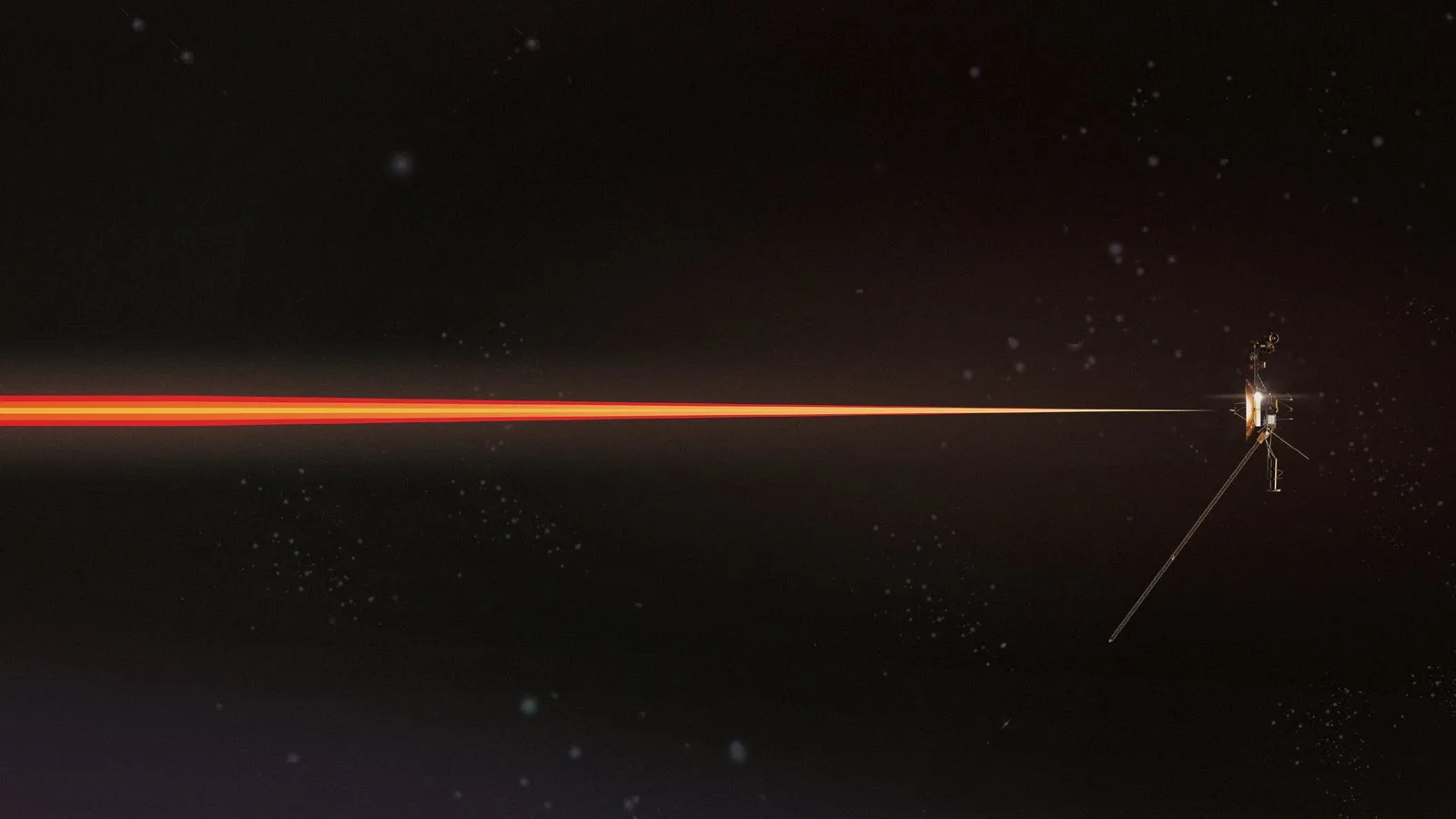
NASA's Voyager 1 spacecraft has become the first human-made object to travel one light-day from Earth, reaching the mark on 18 November 2026 after more than 49 years of constant travel. The probe is now about 16.1 billion miles (25.9 billion km) from home, so far away that a radio signal travelling at the speed of light takes a full day to reach it, and another full day to come back. Here is what a light-day means, how far Voyager 1 has come, and how a spacecraft built in the 1970s is still flying.
What is a light-day?
A light-day is a measure of distance, not time. It is the distance light travels in 24 hours. Light moves at about 186,000 miles (299,000 km) per second in a vacuum, so in one day it covers about 16.1 billion miles (25.9 billion km).
NASA puts the scale in everyday terms. A ray of sunlight passing Earth takes about 1.3 seconds to reach the Moon, about four hours to reach Neptune, and about 20 hours more to reach Voyager 1. The Sun itself is only about eight light-minutes away. Voyager 1 is a full light-day away, about 173 times farther from Earth than the Sun is.
Voyager 1 crossed the mark at 2:16 a.m. PST (5:16 a.m. EST) on 18 November. The team at NASA's Jet Propulsion Laboratory (JPL) in Southern California, which manages the mission, heard from the probe 24 hours later, the time its radio signal took to reach Earth.
How far has Voyager 1 travelled?
Voyager 1 launched from Cape Canaveral on 5 September 1977, sixteen days after its twin, Voyager 2. The two probes were sent to take advantage of a rare alignment of the outer planets. They were only the third and fourth spacecraft to visit Jupiter and Saturn, and the first to return high-resolution images of the planets and their moons.
The mission was planned to last four years. Instead, Voyager 1 kept going. In 2012 it became the first spacecraft to leave the heliosphere, the bubble of particles and magnetic fields created by the Sun, and enter interstellar space. Voyager 2, on a different trajectory, crossed the same boundary in 2018. The two probes remain the only working spacecraft beyond the heliosphere, sending back the only direct measurements of the space between the stars.
Voyager 1 is travelling at about 38,000 mph (61,155 kph). At that speed it has taken nearly 50 years to cover one light-day. To put the distance in perspective, the nearest star system, Proxima Centauri, is 4.24 light-years away, not light-days. Voyager 1 has covered less than 0.1 percent of that distance.
A mission that keeps talking across a day of silence
The distance changes how the mission is flown. A command sent from Earth now takes 24 hours to reach the spacecraft, and its reply takes another 24 hours to return. As Suzanne Dodd, Voyager project manager at JPL, put it: "We listen to Voyager 1 every day and send commands to the spacecraft weekly. It just takes a little longer to communicate than it used to."
That patience was tested twice in recent weeks. In October, NASA lost all contact with the spacecraft for about 48 hours before the signal returned. Then, on 14 November, the probe stopped sending science and engineering data, though it kept sending its carrier signal. NASA said engineers used the carrier signal and trajectory calculations to confirm the light-day milestone, and they continue to analyse the data issue.
"Voyager 1 crossing the light-day threshold is yet another historic feat on an extraordinary voyage of discovery," said Dave Gallagher, JPL director. "Above all, this milestone stands as a testament to the exceptional teams who built, programmed, and fly these spacecraft today."
How the probe is still alive after 49 years
Voyager 1 runs on three radioisotope thermoelectric generators, essentially nuclear batteries that convert heat from decaying plutonium into electricity. The generators supplied about 470 watts at launch and now produce less than half that. Both probes lose about 4 watts of power each year as the plutonium depletes.
Keeping the spacecraft alive has become a slow act of rationing. Engineers have switched off instruments and heaters one by one, in a pre-agreed order, so the instruments that matter most for studying interstellar space can keep running. The cosmic ray subsystem was switched off in February 2025, and the low-energy charged particle experiment was switched off on 17 April 2026. Two science instruments remain in operation: a magnetometer, which measures magnetic fields, and a plasma wave subsystem, which detects plasma waves in the thin material around the spacecraft. The cameras were switched off decades ago to save power.
Earlier this year, engineers turned off three devices on Voyager 1 and substituted three lower-power alternatives, a move NASA said was not without risk, to make the most of the ageing generator. NASA expects the latest energy-saving effort to keep the current science instruments operating until at least the 50th launch anniversaries next summer.
What happens next?
Along with its instruments, Voyager 1 carries a Golden Record, a gold-plated copper phonograph record with images and sounds selected to portray the diversity of life and culture on Earth, as a message to any civilisation that might one day find it. The Empire State Building was lit gold on 17 November to mark the milestone, the colour a nod to that record.
NASA has previously estimated that the Voyager probes could remain within range of its Deep Space Network until about 2036, depending on how much power remains for the transmitter. Until then, the spacecraft will keep sending back measurements from a region no other probe has reached.
"One day in the future, when it can no longer communicate with Earth, Voyager 1 will become humanity's silent ambassador to the stars," said Suzanne Dodd.
Frequently Asked Questions
What is a light-day?
A light-day is the distance light travels in 24 hours, about 16.1 billion miles (25.9 billion km). It is a measure of distance, not time. Voyager 1 reached that distance from Earth on 18 November 2026.
How long does it take to communicate with Voyager 1?
A radio signal travelling at the speed of light takes 24 hours to reach Voyager 1, and its reply takes another 24 hours to return. NASA listens to the probe every day and sends commands weekly.
How much longer can Voyager 1 keep working?
Voyager 1 runs on plutonium-powered generators that lose about 4 watts of power a year. NASA has been switching off instruments to save power, and estimates the probes could stay in contact with Earth until about 2036.
Read More: Explained: Why the Shenzhen Nuclear Declaration Matters
Read More: Explained: Three Cyclones in Three Weeks in the Bay of Bengal
Read More: Explained: Why the Supreme Court Panel Wants Curbs on Riverbed Sand Mining
Read More: Explained: Record $11.3 Billion FPI Inflows Into India



Comments
Be the first to comment on this story.