


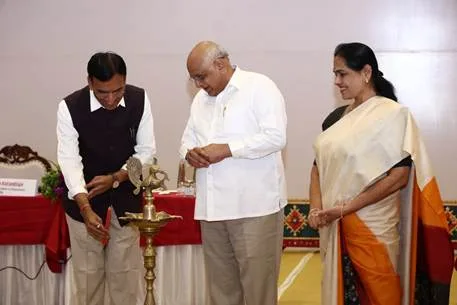
A year after India's four Labour Codes came into effect, the Centre and the states sat down in Gandhinagar on Saturday to take stock. Union Labour Minister Mansukh Mandaviya called workers' welfare and industrial growth the twin wheels of the vehicle of national progress, as a two-day Chintan Shivir opened at Mahatma Mandir. We explain what the codes changed, who they cover, and what is still unfinished.
What happened in Gandhinagar
The two-day Chintan Shivir of Labour and Employment Ministers from states and Union Territories opened on 21 November 2026. Organised by the Ministry of Labour and Employment, it marks exactly one year since the Labour Codes came into effect on 21 November 2025. The inaugural session was co-chaired by Gujarat Chief Minister Bhupendra Patel and Mandaviya, with Union Minister of State Shobha Karandlaje and Labour Secretary Chandra Bhushan Kumar also present.
Day one of the conclave features four thematic plenary sessions covering the status and future course of Labour Code implementation, employment initiatives and EPFO reforms, ESIC reforms, and social security for unorganised workers and labour statistics. Parallel sessions for field officials are focusing on implementation strategies, engagement with micro, small and medium enterprises, and trust-based electronic compliance systems. The discussions are expected to produce recommendations on implementation gaps, international labour mobility and skill development.
The four codes at a glance
The Labour Codes consolidate 29 central labour laws into four codes. The Code on Wages, 2019 covers minimum wages, payment of wages, bonus and equal pay. The Industrial Relations Code, 2020 covers trade unions, standing orders and industrial disputes. The Code on Social Security, 2020 covers provident fund, insurance, gratuity and maternity benefit. The Occupational Safety, Health and Working Conditions Code, 2020 covers factories, contract labour and workplace safety.
Parliament passed the four codes in 2019 and 2020, but they were brought into force only on 21 November 2025. The central rules under the codes followed in May 2026, and the Ministry of Labour and Employment issued an updated set of FAQs on 25 October 2026 to explain several provisions. States must frame their own rules for the codes to take full effect, and that rollout remains uneven across the country.
What changed for workers
The codes bring several concrete changes for workers, including those on fixed-term contracts and in the gig economy.
First, there is now one uniform definition of wages across the codes, and monthly wages must generally be paid before the 7th day of the following month. Second, fixed-term employees get the same benefits as permanent staff doing the same work, including gratuity after one year of service instead of five. Third, gig and platform workers are recognised in law for the first time, and aggregators must contribute 1 to 2 percent of annual turnover to welfare funds, capped at 5 percent of what they pay these workers.
Fourth, every worker, including contract labour, must receive a written appointment letter. Overtime is allowed only with the worker's consent and must be paid at double the normal rate, and annual leave is due after 180 days of work. Fifth, women can now work night shifts and in hazardous roles such as mining, with their consent and with safety measures in place. Contract workers also get free annual health check-ups and social security from the principal employer.
Mandaviya pointed to what he described as a landmark expansion of social security coverage, saying the number of people covered had risen from 25 crore in 2014 to 101 crore in 2026. The standard working week remains 48 hours, eight hours a day. The ministry's FAQs make clear that the codes do not make a four-day workweek compulsory.
What is still pending
The biggest unfinished task is the state-level rollout. The codes can only take full effect once states frame their own rules, and progress on that front has been uneven. Trade unions have also contested parts of the reforms, arguing that some provisions weaken protections for workers. The Chintan Shivir is designed to surface these on-ground implementation problems, share best practices between states, and build consensus on a uniform rollout.
Why the review matters now
Mandaviya described the implementation of the Labour Codes as a significant milestone in India's journey towards becoming a developed nation by 2047. He also pointed to the rising global demand for skilled Indian workers and the country's demographic advantage, saying deliberations on overseas employment opportunities for young people and cross-border labour mobility would be an important area of focus.
Gujarat Chief Minister Bhupendra Patel said workers' dignity, welfare and empowerment were central to the country's nation-building efforts, and that India was moving towards a stronger and more worker-focused labour ecosystem. As the codes enter their second year, the test will be whether the Centre and the states can turn a one-year-old legal framework into uniform protection on the ground.
Frequently Asked Questions
What are India's Labour Codes?
They are four codes that replaced 29 central labour laws, covering wages, industrial relations, social security and workplace safety. They came into effect on 21 November 2025.
What is the biggest change for contract workers?
Fixed-term employees now qualify for gratuity after one year of service instead of five, get the same benefits as permanent staff doing the same work, and must receive a written appointment letter.
Do the codes bring in a four-day workweek?
No. The ministry's FAQs say the standard remains eight hours a day and 48 hours a week. A four-day workweek is not compulsory under the codes.
Read More: Explained: EPFO's New Systematic Withdrawal Plan for Retirees
Read More: Explained: SEBI's Plan to Scrap Extra FPI Disclosure Rules and What It Means
Read More: Explained: Why the ICJ Myanmar Genocide Verdict Matters
Read More: Explained: Delhi's New Waste Rules and the Rs 10,000 Fine for Burning Waste

Comments
Be the first to comment on this story.