


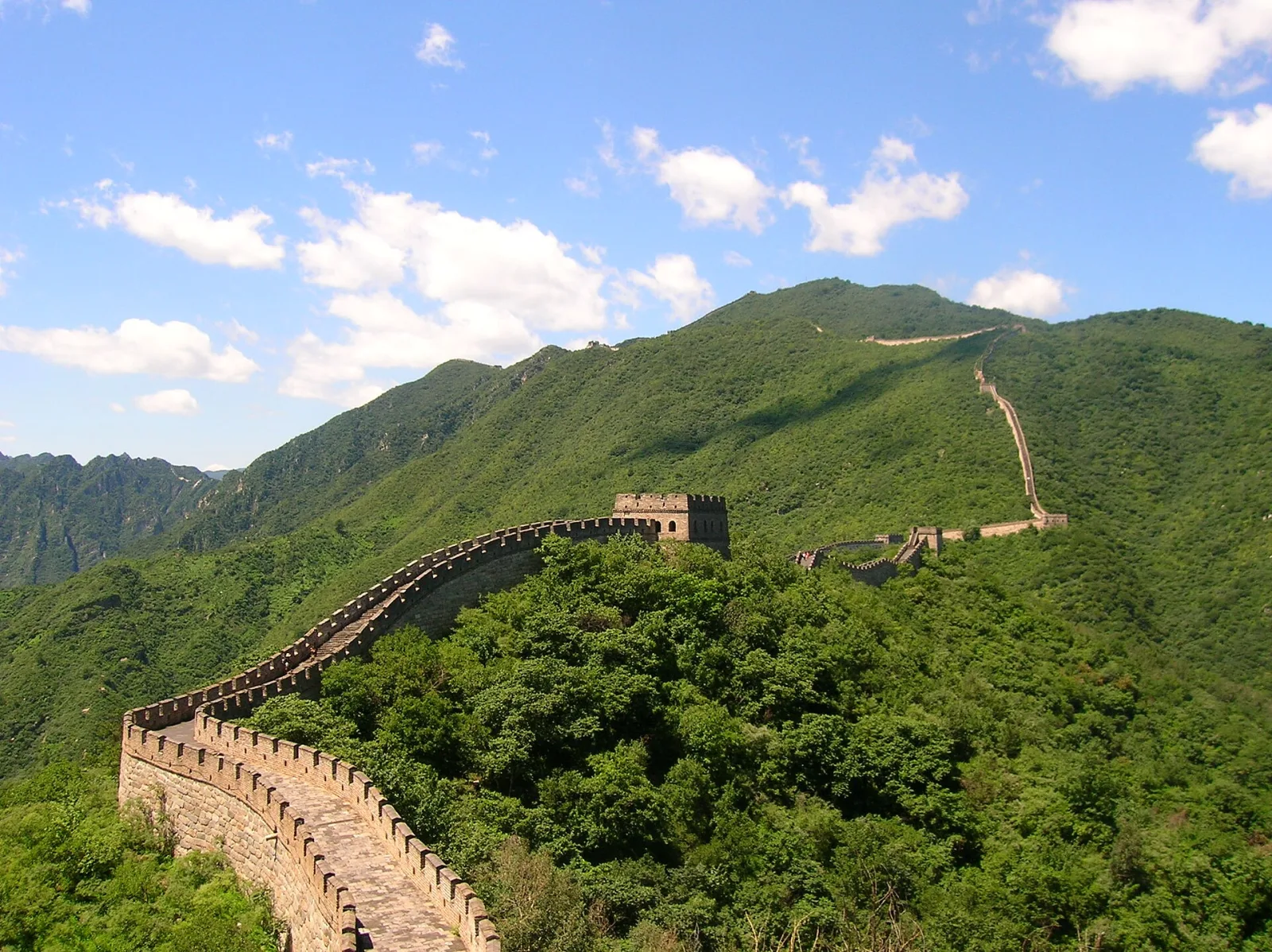
It is one of the most repeated claims in school textbooks and trivia quizzes: the Great Wall of China is the only man-made object visible from space, and some versions of the claim say it can even be seen from the Moon. It sounds plausible. The wall is the longest structure humans have ever built. But the claim is false, and the astronauts who have actually looked for it have said so themselves.
The myth
The story goes that the Great Wall is so long that it stands out from orbit as the one human construction visible from space. Some versions go further and say Apollo astronauts could see it from the Moon. The claim is older than spaceflight itself. As early as 1754, the English scientist and antiquarian Rev. William Stukeley wrote in a private letter about the idea that the wall could be seen from the Moon. It has survived every space mission since, repeated in classrooms and guidebooks for generations.
The wall itself is genuinely enormous. According to China's official survey, it runs 21,196 kilometres in total, including all of its branches, which is 13,171 miles. It was built over more than 2,000 years, and the sections most visitors see today date to the Ming dynasty, from 1368 to 1644. But length is the wrong measure for this claim. What matters is width, and the wall is usually less than 6 metres wide. Even its wider parts are only about 10 metres.
Why the maths does not work
Seeing something from far away is a question of resolution, which is the eye's ability to tell two close objects apart. The average human eye can resolve detail down to about one arcminute, which is one sixtieth of a degree. Anything smaller than that merges into a single dot or disappears altogether.
Scientific American works through the numbers. From the Moon, about 380,000 kilometres away, the wall would appear as a line one ten-thousandth of an arcminute thick. Resolving it would be roughly the equivalent of seeing a human hair from a kilometre away with unaided eyes. From low Earth orbit, about 400 kilometres up where the International Space Station flies, the wall would appear about 0.1 arcminute wide. That is still below what the eye can resolve.
The eye can do slightly better with objects that are very long and stand out sharply against their background. Orbiting astronauts can see roads across deserts, for example. The wall gets no such help. Its brown and tan stone blends into the surrounding terrain, and it curves as it follows the landscape, especially near steep cliffs and hills.
What the astronauts actually saw
The evidence from the people who have been there is direct. China's first taikonaut, Yang Liwei, said after his Shenzhou 5 flight in 2003 that he could not see the wall from orbit. Canadian astronaut Chris Hadfield, who lived on the International Space Station in 2012 and 2013, said the Great Wall is not visible from orbit with the naked eye because it is too narrow and follows the natural contours and colours of the landscape. Apollo 12 astronaut Alan Bean summed up the view from the Moon in a single line: "No man-made object is visible at this scale."
Photographs of the wall from orbit do exist, but only with telephoto lenses, which have far higher resolution than the human eye. US astronaut Leroy Chiao photographed it from the International Space Station on 24 November 2004 with a digital camera and a 180mm lens. ESA astronaut Alexander Gerst photographed it on 19 June 2018 with an 800mm telephoto lens, writing: "Next to impossible with the naked eye. But I tried with an 800 mm tele lens. Still tough to spot."
The confusion this causes is real. In 2004, the European Space Agency briefly revived the myth by publishing a photo said to show the wall from orbit. A week later it acknowledged that the feature in the photo was actually a river. A 2008 paper in the Journal of Optometry worked through the optics and reached the same conclusion: seeing the wall from 160 kilometres up would be like looking at a 2 centimetre cable from more than half a kilometre away, needing vision of about 20/3, far beyond human ability.
There is one narrow exception. When the sun is low at sunrise or sunset, the wall can cast a long shadow that reveals its presence. But that is spotting the shadow, not seeing the wall itself.
The kernel of truth
The myth survives partly because some man-made things really are visible from orbit with the naked eye. The Great Pyramid of Giza is about 230 metres across at its base, and Leroy Chiao claims to have seen two of the pyramids. NASA says the Three Gorges Dam in China can be seen from space: it is more than 100 metres across at its base and 2.3 kilometres long, and its tan colour contrasts with the blue waters of the Yangtze. City lights at night are easily seen from orbit too.
The difference is size and contrast. The pyramids and the dam are hundreds of metres across and stand out against their surroundings. The wall is a few metres wide and coloured like the hills it runs through. Being the longest structure humans have built does not make it the most visible one.
Verdict: False
The Great Wall of China cannot be seen from space with the naked eye, from low Earth orbit or from the Moon. It is too narrow and blends into the terrain. Astronauts Yang Liwei and Chris Hadfield both confirmed they could not see it, and the only orbital photographs of it were taken with telephoto lenses. The claim belongs in the classroom as an example of a good story that fails the maths, not as a fact about spaceflight.
Frequently Asked Questions
Can you see the Great Wall of China from space?
No, not with the naked eye. From the International Space Station it would appear about 0.1 arcminute wide, below what the human eye can resolve, and its stone blends into the surrounding terrain.
Has any astronaut seen the Great Wall from orbit?
No astronaut has reliably seen it with the naked eye. Yang Liwei in 2003 and Chris Hadfield in 2012-13 both said they could not. Photographs exist only with telephoto lenses, such as Leroy Chiao's 180mm shot in 2004 and Alexander Gerst's 800mm shot in 2018.
What man-made objects can be seen from space?
City lights at night, the Pyramids of Giza and the Three Gorges Dam are visible from orbit. The pyramids are about 230 metres across at the base and the dam is more than 100 metres wide, far bulkier than the wall's few metres.
Read More: Myths and Facts: Lightning Does Strike the Same Place Twice
Read More: Myths and Facts: Bats Are Not Blind, They Can See Well
Read More: Myths and Facts: Ostriches Do Not Bury Their Heads in the Sand
Read More: Myths and Facts: We Use All of Our Brain, Not Just 10 Percent



Comments
Be the first to comment on this story.