


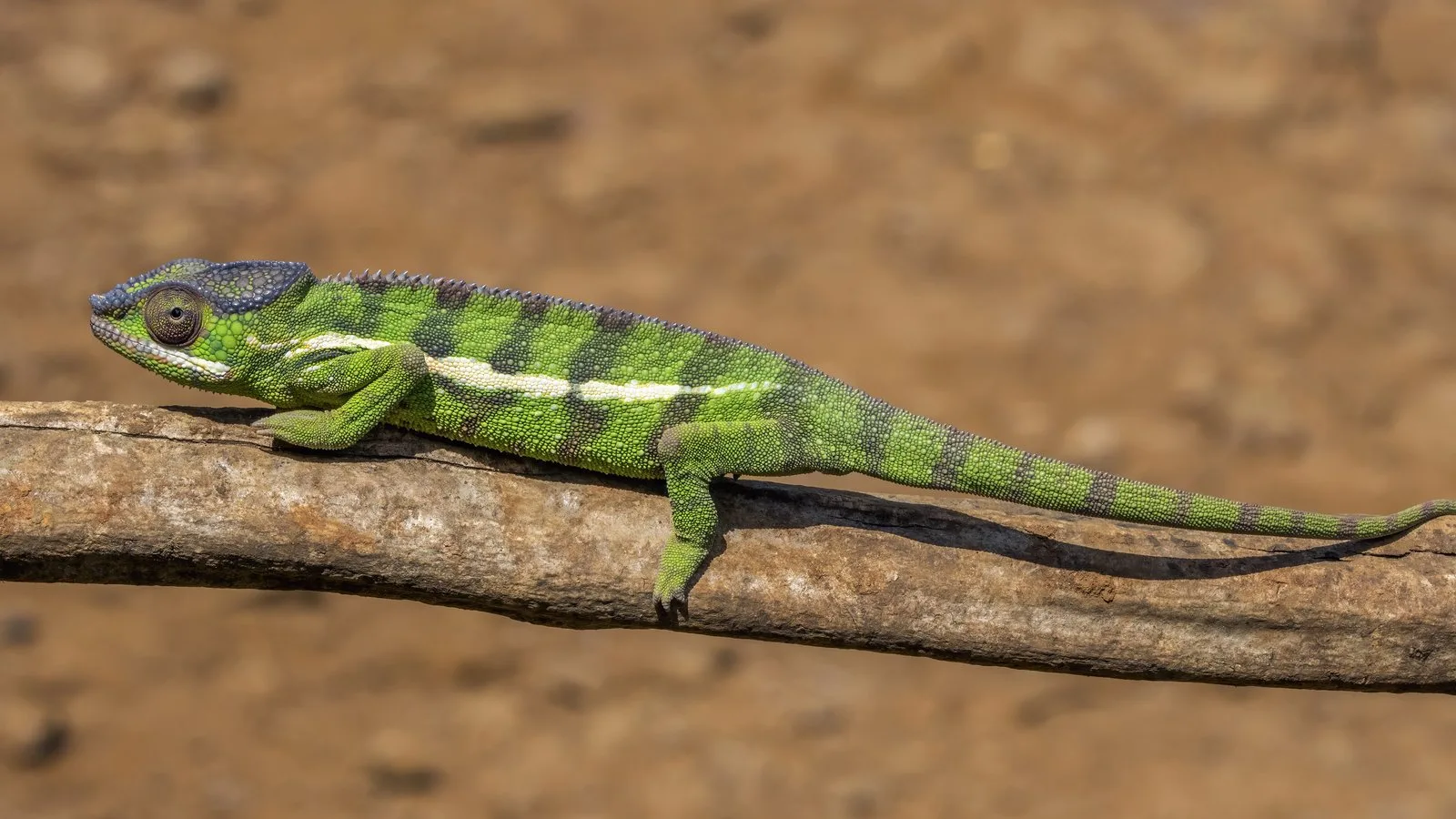
Put a chameleon on a chessboard and it will turn black and white. Put it on a pink curtain and it will turn pink. It is one of the most repeated animal facts in the world, helped along by cartoons like Pascal, the colour-changing chameleon in Disney's Tangled. The only problem is that it is not true. A chameleon cannot copy the background it sits on, and camouflage is not the main reason its skin changes colour. Verdict: False.
Where the myth comes from
The myth is older than the cartoons. Aristotle noted the chameleon's colour-changing skin more than two thousand years ago, and ever since, the animal has been presented as nature's master of disguise. Popular culture finished the job. In Tangled, Pascal changes colour on a whim to match whatever is behind him, and countless videos on social media appear to show chameleons shifting shade as they cross different coloured surfaces.
Michel Milinkovitch, an evolutionary geneticist at the University of Geneva and an expert on animal skin colour, told National Geographic that the chessboard idea is simply not true, and that many of the videos showing lizards changing colour as they meet different surfaces are completely fake. Real chameleons do change colour, often dramatically. But the change is not a copy of the background. It is a signal, and a thermostat.
How a chameleon actually changes colour
For years, scientists thought chameleons changed colour by spreading pigment through their skin cells. That theory collapsed in 2015, when Milinkovitch and his colleagues at the University of Geneva published a study in the journal Nature Communications on the panther chameleon.
Under the skin they found two layers of specialised cells called iridophores, packed with tiny crystals of guanine arranged in a lattice. When the chameleon is relaxed, the crystals sit close together and reflect short wavelengths of light, which appear blue and green. When it gets excited, the skin relaxes, the crystals spread apart, and the reflected light shifts through green, yellow, orange and red. The colour is set by physics, by the spacing of the crystals, not by the colour of the leaf underneath.
Britannica puts it plainly: contrary to popular belief, chameleons do not change colour to blend into their background. The colour is controlled by hormones, temperature and the autonomic nervous system. A green chameleon cannot turn pink, because its skin simply cannot produce that colour on demand. As one open textbook correction notes, a green veiled chameleon will not turn pink just because it is put in a pink box.
Why they really change colour
Research points to two main reasons: communication and temperature control. Colour is the chameleon's language. A male meeting a rival will darken and flare bright colours to look bigger and more threatening. A male courting a female will show off lighter, brighter hues as a sign of health. An angry or stressed chameleon turns dark, while a relaxed one stays light.
A 2013 study by Russell Ligon and Kevin McGraw of Arizona State University watched 45 encounters between captive veiled chameleons. Before fighting, the males brightened the vivid stripes on their sides to show off their health and look larger. The researchers found that the brightness of those displays could even predict which lizard would win the fight.
Temperature is the second driver. A cold chameleon turns dark in the morning to absorb more heat from the sun and shorten its basking time. A hot chameleon turns pale to reflect heat away from its body. Lightening the skin is a way of cooling down, and darkening it is a way of warming up.
The small part camouflage does play
None of this means camouflage plays no role at all. Most chameleons spend their lives in trees, among brown branches and green leaves, and their natural green and brown skin already looks like the surroundings. Milinkovitch says much of the blending in a chameleon does needs no colour change at all, because in its natural state it already looks like a leaf or a branch.
They can also make small adjustments. Devi Stuart-Fox, an evolutionary biologist at the University of Melbourne who has studied chameleon colour for more than a decade, told National Geographic that in dim light, dark pigment cells called melanophores flood the skin surface and make the animal darker, like putting a dark wash over a painting. So a chameleon can tune its brightness to suit shade or sunlight. What it cannot do is match a flower, a blade of grass, a chessboard or a pink curtain. The range of its changes is a narrow slice of the colour wheel, and the big, dramatic shifts are for rivals and mates, not for hiding.
Verdict: False
Chameleons do not change colour to match their background. They cannot copy a pattern or a colour they are placed on, and the viral videos that seem to show them doing so are staged or fake. Their colour changes are driven by mood, communication and temperature, with the crystal lattice in their skin shifting the reflected light from blue to red as they relax or get excited. Camouflage plays only a small part, in small brightness adjustments and in the green and brown skin they are born with. The myth is false.
Frequently Asked Questions
Can a chameleon turn any colour to match its background?
No. A chameleon can only shift within its own range of colours, set by the crystal lattice in its skin. It cannot copy a chessboard pattern, turn pink on a pink curtain, or match a bright flower. Its dramatic colour changes are for communication and temperature control.
Why do chameleons change colour then?
Mainly to communicate and to control body temperature. Bright colours signal health to a mate or warn off a rival, dark colours show stress or aggression, and a cold chameleon darkens to absorb heat while a hot one lightens to reflect it away.
Are the colour-change videos on social media real?
Many are not. Michel Milinkovitch of the University of Geneva says videos showing chameleons changing colour as they cross different surfaces are completely fake. Real colour changes happen over seconds and are driven by the animal's mood and temperature, not by the surface beneath it.
Read More: Myths and Facts: Bats Are Not Blind, They Can See Well
Read More: Myths and Facts: Ostriches Do Not Bury Their Heads in the Sand
Read More: Myths and Facts: The Great Wall of China Is Not Visible From Space
Read More: Myths and Facts: We Use All of Our Brain, Not Just 10 Percent



Comments
Be the first to comment on this story.