


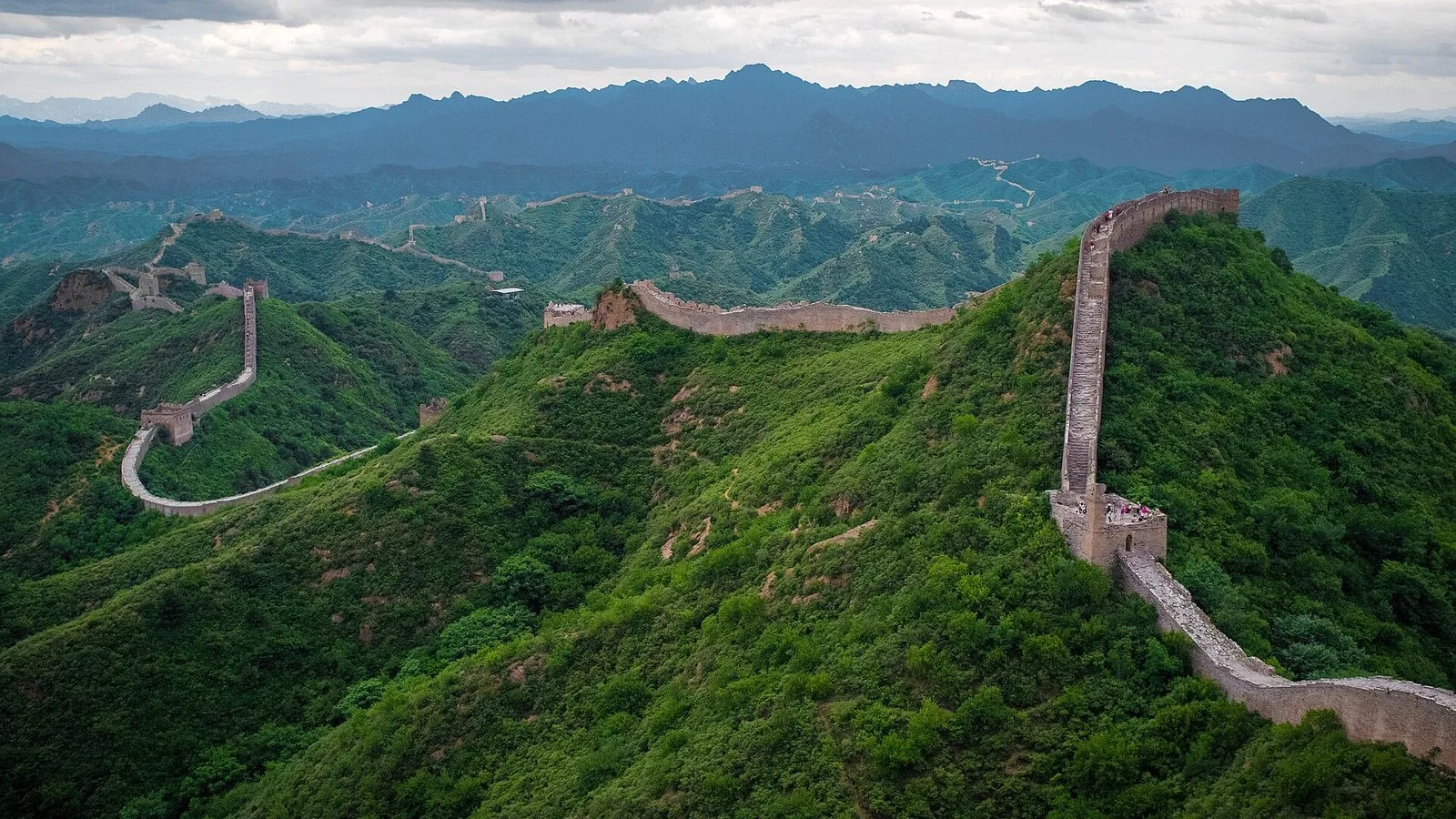
One of the most repeated claims in school textbooks and trivia quizzes says the Great Wall of China is the only human made object visible from space, and that astronauts can spot it from the Moon. Astronauts who have actually been there say the opposite. The wall is far too narrow to see with the naked eye, and no astronaut has ever reliably picked it out without the help of a camera lens. Verdict: False.
Where the claim comes from
The claim is older than spaceflight itself. One of the earliest known mentions appears in a 1754 letter by the English antiquarian William Stukeley, who wrote about the wall being so vast that it must be visible from the Moon. The idea survived for more than two centuries without ever being tested, because nobody had been to space to check it. It was repeated in books, classrooms and travel guides until it became one of the most believed facts about the wall. When humans finally did reach the Moon, the claim fell apart.
What astronauts actually saw
Apollo 12 astronaut Alan Bean put it plainly after his mission. He said the only thing you can see from the Moon is a beautiful sphere, mostly white, some blue and patches of yellow, and every once in a while some green vegetation, and that no man made object is visible at this scale. No Apollo astronaut ever reported seeing the wall from the Moon.
The view from low Earth orbit is not much better. Yang Liwei, the first Chinese astronaut in space, said in 2003 that he could not see the Great Wall from orbit, even though national pride would have given him every reason to say otherwise. Former International Space Station commander Chris Hadfield confirmed the same, writing that the wall is too narrow and follows the natural contours and colours of the land.
The strongest proof came from the astronauts who tried to photograph it. On 24 November 2004, US astronaut Leroy Chiao took the first photograph of the Great Wall from space, using a digital camera with a 180mm lens. Chiao later admitted he could not see the wall with his own eyes when he took the photo. In June 2018, European Space Agency astronaut Alexander Gerst tried again from the International Space Station with an 800mm telephoto lens and wrote that it was next to impossible with the naked eye, and still tough to spot even through the lens.
The maths of why it cannot be seen
The wall is enormously long but very narrow, and length is not what matters for visibility. The Great Wall stretches more than 21,000 kilometres in total, including all its branches, but it is typically only six to seven metres wide. From hundreds of kilometres above Earth, that width is far too small for the human eye to resolve.
The human eye can resolve detail down to about one arcminute. From the Moon, the wall would appear about one ten thousandth of an arcminute thick, which Scientific American compares to trying to see a human hair from a kilometre away with unaided eyes. From the International Space Station, about 400 kilometres above Earth, the wall would still appear only about 0.1 arcminutes wide, well below what the eye can pick out.
Colour makes it harder still. The wall is built from stone, brick and tamped earth, so its colour closely matches the hills and terrain it runs through. Unlike a road across a desert, which stands out against pale sand, the wall does not contrast sharply with the landscape around it. It also curves and follows ridges and cliffs, so it never forms a straight line that the eye could follow.
What can be seen from space
Other human made structures are much easier to spot. NASA notes that large cities, especially at night when they are lit up, large airports and long bridges can all be seen from low Earth orbit. The Bingham Canyon Mine in Utah, the Three Gorges Dam in China and the Palm Jumeirah islands in Dubai are all visible from space without magnification, because they are far wider than the wall. The Great Wall is remarkable for its length and history, not for its visibility from orbit.
Verdict: False
The Great Wall of China cannot be seen from space with the naked eye, and it certainly cannot be seen from the Moon. Astronauts from the United States, China and Europe have all tried and failed to spot it without a camera, and the physics of human vision explains why. Photographs taken from orbit with long telephoto lenses show the wall, but that is the camera doing the work, not the eye. The myth is false.
Frequently Asked Questions
Can you see the Great Wall of China from the Moon?
No. Apollo 12 astronaut Alan Bean said no man made object is visible from the Moon. From that distance the wall would be far too narrow for the human eye to resolve.
Has any astronaut seen the Great Wall from space with the naked eye?
No astronaut has reliably done so. Yang Liwei said in 2003 he could not see it from orbit, and Chris Hadfield confirmed it is too narrow and blends into the terrain. Leroy Chiao photographed it in 2004 with a 180mm lens but could not see it with his own eyes.
Why is the Great Wall so hard to see from space?
It is only about six to seven metres wide, far too narrow for the human eye to resolve from hundreds of kilometres up, and its stone and brick colours closely match the surrounding hills. Its winding path along ridges makes it even harder to pick out.
Read More: Myths and Facts: Vikings Did Not Wear Horned Helmets
Read More: Myths and Facts: Humans Have More Than Five Senses
Read More: Myths and Facts: Einstein Did Not Fail Maths at School
Read More: Myths and Facts: Daddy Longlegs Are Not the Most Venomous Spiders
Comments
Be the first to comment on this story.