


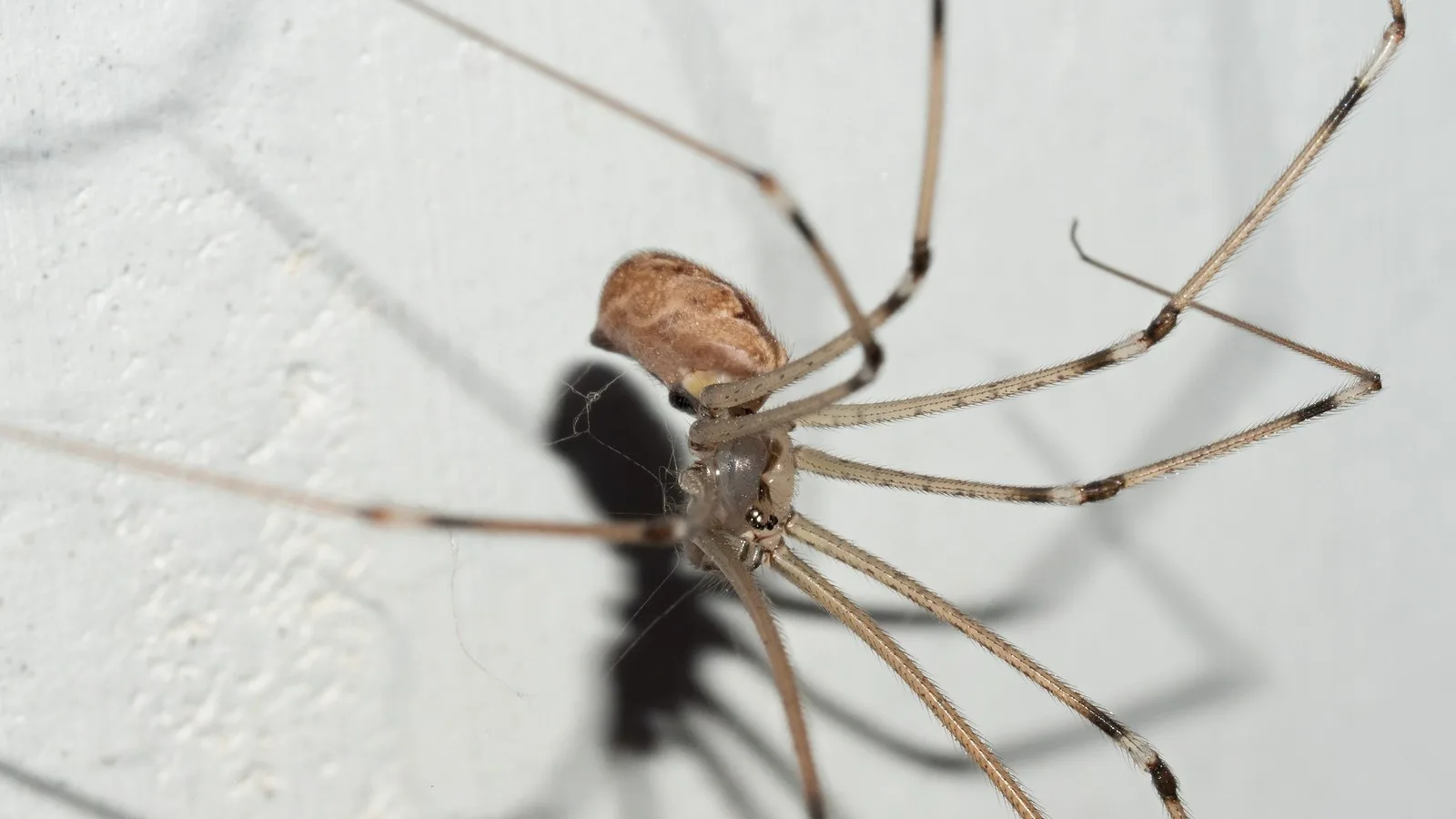
It is one of the most repeated playground legends in the world. Daddy longlegs are the most venomous spiders on Earth, and the only reason they never kill anyone is that their fangs are too short to pierce human skin. The verdict is simple: it is a myth, and both halves of it are wrong. Their venom is not the most potent of any spider, and their fangs can pierce human skin. When they do, the result is little more than a mild sting.
The claim
The story is told in schoolyards and repeated in trivia quizzes. Somewhere out there lives a spider with venom deadlier than a black widow's, and the only thing standing between us and it is a fang too short to break the skin. It is a neat story, and it feels true, because the spider in question really does look fragile: a tiny body carried on absurdly long, thin legs, hanging upside down in the corner of a room.
The problem is that the story was never based on any measurement. No scientific study has ever shown that a daddy longlegs has the most toxic venom of any spider. Arachnologists have treated the claim as an urban legend for years, and the evidence, where it exists at all, points the other way.
Three animals, one name
The first thing to get straight is that "daddy longlegs" is not one animal. The name is used colloquially for at least three different creatures, and only one of them is a true spider.
The true spider is the cellar spider, from the family Pholcidae. The familiar one is the long-bodied cellar spider, Pholcus phalangioides, the pale, long-legged spider found in the corners of houses around the world. Like other spiders it has two body segments, eight eyes, and fangs connected to venom glands. The family is large, with 1,714 species in 94 genera recorded in the World Spider Catalog, and it has been diversifying for more than 200 million years.
Then there are harvestmen, arachnids in the order Opiliones. They have a single body segment and only two eyes, and they have no fangs and no venom glands at all. They have small grabbing mouthparts used for tearing apart prey, dead animals and detritus. When disturbed, some harvestmen spray or coat themselves in a dark, foul-smelling chemical mixture meant to ward off parasites and predators. That substance can kill spiders and insects, but it is certainly not the most toxic poison in the world.
Finally there are crane flies, in the family Tipulidae. These are insects, not arachnids at all. Their long bodies and wings make them look like oversized mosquitoes, but unlike mosquitoes they cannot bite. Many species have no mouthparts at all, and the adults live for only a few days, long enough to mate and lay eggs.
So for two of the three animals called daddy longlegs, the legend is plainly false: they have no venom to speak of. The claim has to stand or fall on the cellar spider alone.
What the venom tests found
Cellar spiders can bite humans, and the tests show the bite is not dangerous. Their fangs are tiny, about a quarter of a millimetre long, with a hooked shape that is similar in structure to the fangs of the brown recluse, a spider notorious for its potentially serious bite. But the similarity ends there.
The most famous test was carried out by the television programme MythBusters in 2004, in episode 13, "Buried in Concrete". The hosts first looked at an experiment in which mice were injected with venom from a daddy longlegs and from a black widow. The black widow venom produced a much stronger reaction. Then host Adam Savage put his hand into a container holding several daddy longlegs. He was bitten, and he reported a mild, short-lived burning sensation. The bite did penetrate his skin, which disproved the short-fangs half of the legend, but it caused no notable harm.
The research since then agrees. In 2019, a team led by Pamela Zobel-Thropp published the first formal study of a cellar spider's venom, analysing the venom of Physocyclus mexicanus, a relative of the common cellar spider, in the journal Frontiers in Ecology and Evolution. They found the venom is potent against insects, which is what the spider actually hunts, but only weakly toxic to mammals, and the amount a single spider delivers is tiny. Documented bites on humans made the same point: a mild sting with no long-lasting effects. The researchers concluded that the effects of pholcid venom on humans and other mammals are inconsequential.
Rick Vetter, a retired research associate of entomology at the University of California, Riverside, who has spent years correcting this myth, put it plainly. He said he was not aware of any publication showing that pholcid spiders cause a toxic effect in humans, and that they are definitely not the most toxic spider in the world. According to Vetter, a daddy longlegs spider has never harmed a human, and there is no evidence that they are dangerous to people.
Where the myth came from
If the venom is weak, why did the story take hold? The most likely explanation, suggested by the Australian Museum, is that cellar spiders really do kill dangerous spiders. A cellar spider can kill and eat a redback, the Australian relative of the black widow. It does this not by out-venoming its prey but by flicking lengths of silk at it from a safe distance, tangling it up before moving in.
To someone watching, the logic seemed obvious. If this fragile-looking spider can kill a spider capable of delivering a fatal bite to a human, then its venom must be stronger still, and the only reason it never kills people must be that its fangs cannot reach us. Both steps of that reasoning are wrong, but the story was too good to check, and it spread.
The verdict
Daddy longlegs are not the most venomous spiders in the world. The name covers three different animals, two of which have no venom at all. The one that does, the cellar spider, has venom that is weak in mammals. Its fangs can pierce human skin, and the result, tested on television in 2004 and confirmed by venom research in 2019, is a brief, mild sting and nothing more. The spider in the corner of the room is not a loaded weapon with a safety catch. It is a harmless houseguest that eats other spiders, including the dangerous ones.
Frequently Asked Questions
Are daddy longlegs the most venomous spiders in the world?
No. Cellar spider venom is potent against insects but only weakly toxic to mammals, and the amount delivered in a bite is tiny. A 2019 study of the cellar spider Physocyclus mexicanus found the effects of its venom on humans and other mammals to be inconsequential, and no publication has shown a pholcid spider causing a toxic effect in a human.
Can a daddy longlegs bite a human?
Yes. The television programme MythBusters tested this in 2004 and found that a cellar spider's fangs, about a quarter of a millimetre long, can penetrate human skin. The bite produced only a mild, short-lived burning sensation and caused no notable harm.
Why do people believe daddy longlegs are so venomous?
Probably because cellar spiders kill redbacks and other dangerous spiders. They do it by flicking silk at their prey from a safe distance, not with powerful venom. People reasoned that a spider able to kill a black widow must have stronger venom, but the Australian Museum notes that cellar spider venom is not particularly potent, even against insects.
Read More: Myths and Facts: Vikings Did Not Wear Horned Helmets
Read More: Myths and Facts: Humans Have More Than Five Senses
Read More: Myths and Facts: Einstein Did Not Fail Maths at School
Read More: Myths and Facts: Sugar Does Not Make Children Hyperactive

Comments
Be the first to comment on this story.