


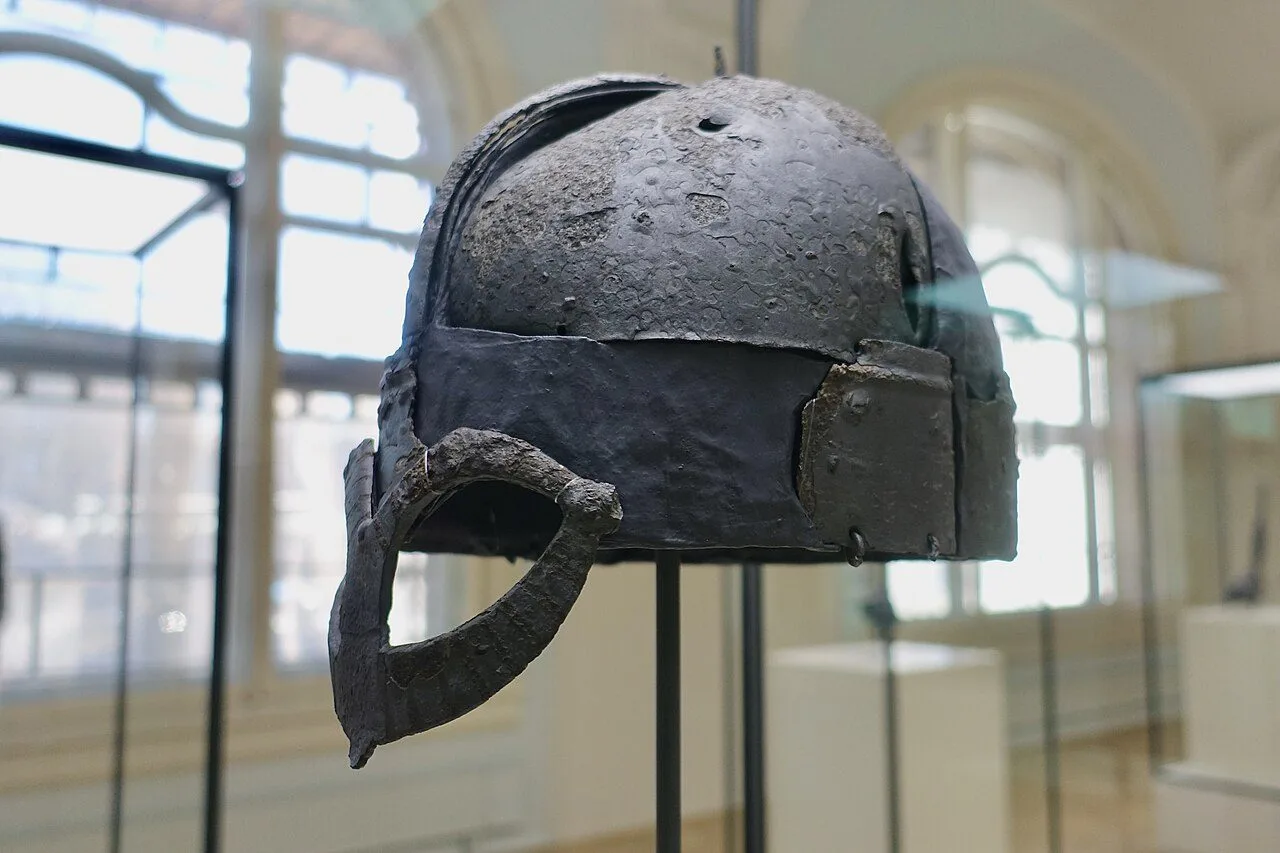
Picture a Viking and you picture a horned helmet. It is on Halloween costumes, cartoon characters, sports mascots and toy figures, and it has become the instant visual shorthand for everything Norse. The verdict is clear: it is a myth. No Viking ever wore a horned helmet, and no horned helmet has ever been found in a Viking Age dig.
What archaeology actually found
The evidence is not thin, it is empty. Archaeologist Ingrid Ystgaard of the Norwegian University of Science and Technology states it plainly: helmets from the Viking Age with horns on them have never been found. Not one has turned up in any excavation, in Scandinavia or anywhere else the Vikings travelled.
What has been found is the opposite of a horned helmet. Only one complete Viking helmet survives anywhere in the world. It is the Gjermundbu helmet, found in nine fragments in a Viking grave at a farm near Haugsbygd in Norway in 1943, and restored since. It dates to the 10th century, is made of iron from four plates, has a rounded cap and a guard around the eyes and the nose, and has no horns at all. It is on display at the Museum of Cultural History at the University of Oslo. Only two other Viking helmet finds exist, one at Tjele in Denmark and one at Lokrume on the island of Gotland in Sweden, and both are fragments of the same plain kind. From runestones and other illustrations, archaeologists know the Vikings also wore simpler helmets, often peaked caps with a simple nose guard, and many probably wore leather caps or nothing at all.
Horned helmets did exist, just not Viking ones
The confusion has a real root. Horned helmets really were made in northern Europe, but about 2,000 years before the Viking Age began. The Viksø helmets, found in a Danish bog in 1942, date to the Bronze Age, around 3,000 years ago. They carry horns, eyes and a nose, and archaeologists believe they were used in religious ceremonies and then placed in the bog as offerings. They were ritual objects, not battle gear.
Pictures from the Merovingian period, around 550 to 800, also show figures wearing horned headgear, but archaeologists believe those were decorative helmets worn by high status people, not warriors. A ninth century tapestry from the Oseberg ship burial shows a figure in horned headgear, and that figure is thought to be a god, not a Viking. The famous helmet plaques from Sutton Hoo and Vendel show protrusions that look like horns at a glance, but on close inspection they are hook beaked birds.
There is also a practical point. A pair of horns on a helmet would be heavy, awkward and easy for an enemy to grab in close fighting. It would be a hindrance in battle, not a help.
Where the horned Viking came from
The horned helmet was invented in the 19th century, not the ninth. Romantic artists of the 1800s imagined the Vikings as wild northern warriors, and the image was fixed for good by opera. When Richard Wagner's Der Ring des Nibelungen was first performed in 1876, costume designer Carl Emil Doepler dressed the Viking characters in horned helmets. The image was so striking that it stuck, and within a few decades it had spread from the stage to illustrations, cartoons, advertising, films and toys, until it became the way everyone pictures a Viking.
Historian Roberta Frank, who wrote the study The Invention of the Viking Horned Helmet in 2000, summed up the connection in one line: until the Viking Age was invented, there was no horned helmeted Viking. The horned helmet and the popular idea of the Viking Age were created together, in the 1870s, about a thousand years after the real Vikings had gone.
The verdict
Vikings did not wear horned helmets. The only complete Viking helmet ever found is a plain iron cap with an eye and nose guard. Horned helmets belong to the Bronze Age, some 2,000 years earlier, and to ritual and ceremony rather than battle. The horns on the helmet in the cartoon come from a 19th century opera costume, and they have been misleading audiences ever since.
Frequently Asked Questions
Did Vikings wear horned helmets?
No. No horned helmet has ever been found in a Viking Age dig. The only complete Viking helmet ever found, the Gjermundbu helmet from 10th century Norway, is a plain iron cap with a guard around the eyes and nose.
What did a real Viking helmet look like?
The Gjermundbu helmet is made of iron from four plates, with a rounded cap and a guard for the eyes and nose. Other evidence points to simpler helmets, often peaked caps with a nose guard, or leather caps.
Where did the horned helmet idea come from?
It comes from 19th century art and opera. Costume designer Carl Emil Doepler created horned helmets for Wagner's Der Ring des Nibelungen, first performed in 1876, and the image spread from the stage into cartoons, films and toys.
Read More: Myths and Facts: Lightning Does Strike the Same Place Twice
Read More: Myths and Facts: A Glass of Red Wine Is Not Good for Your Heart
Read More: Myths and Facts: The Five-Second Rule Does Not Keep Dropped Food Safe
Read More: Myths and Facts: Bulls Do Not Hate the Colour Red


Comments
Be the first to comment on this story.