


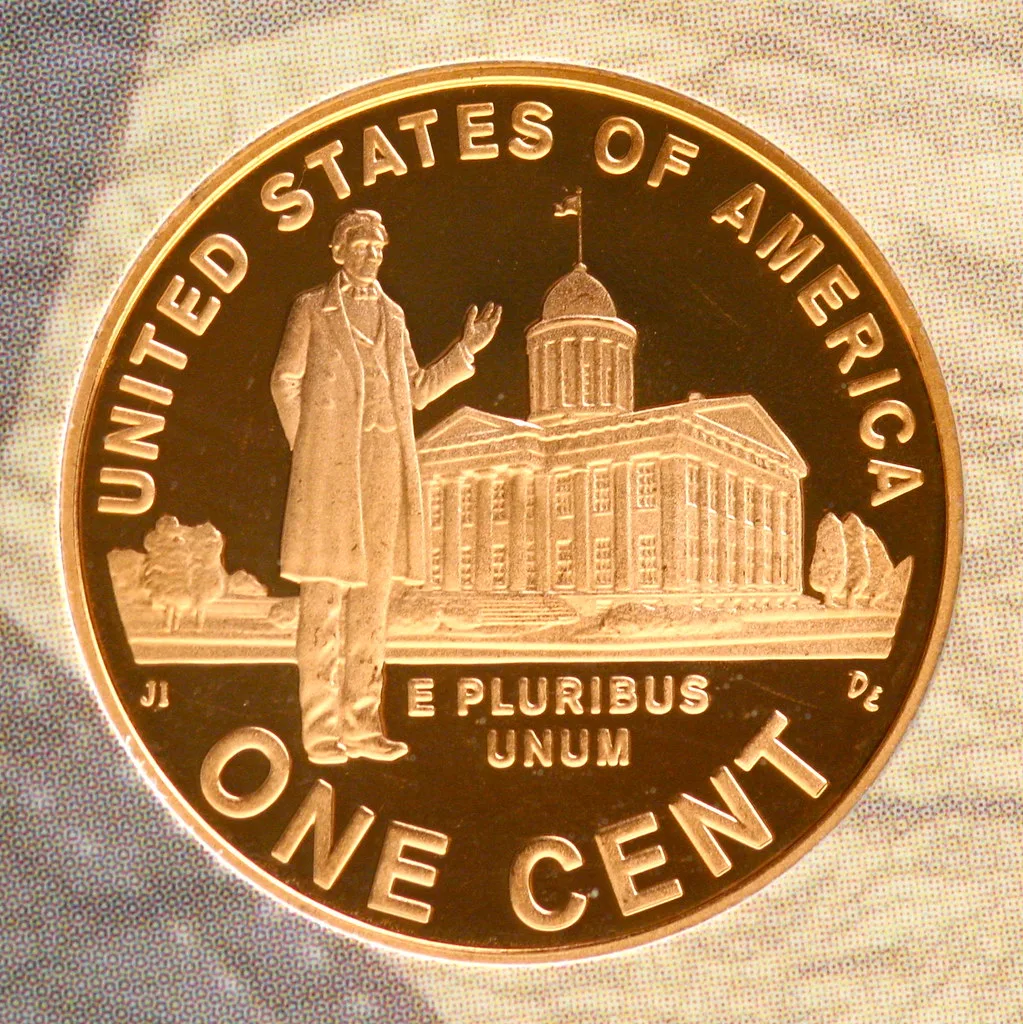
Drop a penny from the top of a skyscraper and it will punch through a pedestrian's skull, or so the old story goes. The verdict is simple: it is false. A falling penny tops out at about 40 kmph, it would sting like a flick on the forehead, and it could not kill anyone. Physicists worked this out with wind tunnels, and MythBusters tested it on a replica skull. Both reached the same answer.
The myth
The story is one of the oldest pieces of city folklore. A tourist on the observation deck of the Empire State Building drops a penny, and by the time it reaches the street it is moving like a bullet. Anyone unlucky enough to be standing below is finished. It sounds plausible. Things do speed up as they fall, and 320 metres is a long way down. But the story leaves out the air.
What the physics says
A penny is light and flat, which is the worst possible combination for falling fast. A US one-cent coin weighs 2.5 grams and is 19.05 mm across, so it catches a lot of air for its weight. As it falls, air resistance grows until it exactly cancels gravity, and from that point the coin stops speeding up. That steady speed is called terminal velocity.
University of Virginia physicist Louis Bloomfield worked out the numbers with wind tunnels and high-speed cameras. A tumbling penny reaches its terminal velocity after falling only about 15 metres, and that speed is roughly 25 miles per hour, about 40 kmph. No building, however tall, can make it fall faster. It flutters down more like a falling leaf than a bullet.
At that speed a 2.5 gram penny carries about 0.15 joules of energy. Bloomfield described the impact as a flick on the forehead. Fracturing a human skull takes tens of joules, more than 70 times as much. The numbers alone settle the question.
What MythBusters found
The television series MythBusters tested the claim directly in its Penny Drop episode, first shown on 17 October 2003. The team fired pennies at terminal velocity into disks of concrete and asphalt and into a ballistics gel head fitted with a human skull. The pennies did not penetrate any of them. Even when the team fired a penny from a rifle, it could not penetrate the concrete or the gel dummy's skull. A real bullet, fired for comparison, split the dummy skull. The myth was declared busted.
The show tested at 65 miles per hour, well above the 25 miles per hour Bloomfield calculated. Even at that higher speed, the penny could not do lethal damage.
Why it would never reach the street
There is a second problem with the story, and it has nothing to do with physics. The Empire State Building is stepped, so a coin dropped from the 86th-floor observation deck, 320 metres up, would land on a lower roof rather than the street. Updrafts around the tower push light objects back against the building. Coins dropped from the deck end up on the roof of the 80th floor, where electricians collect them when they change the lights. The penny would never reach a pedestrian at all.
The grain of truth
The myth survives because the idea behind it is half right. Things dropped from a height can kill. Construction sites require hard hats for exactly that reason: a spanner or a bolt falling from scaffolding carries far more mass than a penny and can be lethal. Even a golf ball dropped from the top of the Empire State Building would be dangerous, because it is heavier and rounder and falls much faster than a coin. The mistake is to treat every falling object the same. A penny is too light and too flat to build up a dangerous speed, no matter how far it falls.
The verdict
A penny dropped from a skyscraper cannot kill you. Air resistance caps its speed at about 40 kmph after only 15 metres of falling, and at that speed it carries far too little energy to fracture a skull. MythBusters fired pennies at even higher speeds into a replica skull and could not make one penetrate. The story is a myth, and the only real danger from a falling coin is a small bruise.
Frequently Asked Questions
How fast does a penny fall from a skyscraper?
About 25 miles per hour, or 40 kmph. A tumbling penny reaches that speed after falling only about 15 metres, and air resistance stops it going any faster, no matter how tall the building is.
Could a penny dropped from the Empire State Building kill someone?
No. Physicist Louis Bloomfield calculated that it would feel like a flick on the forehead, and MythBusters fired pennies into a replica skull at even higher speeds without penetrating it.
Are falling objects from buildings ever dangerous?
Yes. Heavier objects such as tools can be lethal, which is why construction sites require hard hats. The penny is safe because it is light and flat, not because falling objects are harmless.
Read More: Myths and Facts: You Cannot See the Great Wall of China From Space
Read More: Myths and Facts: Lightning Does Strike the Same Place Twice
Read More: Myths and Facts: Goldfish Do Not Have a Three Second Memory
Read More: Myths and Facts: The Five-Second Rule Does Not Keep Dropped Food Safe



Comments
Be the first to comment on this story.