


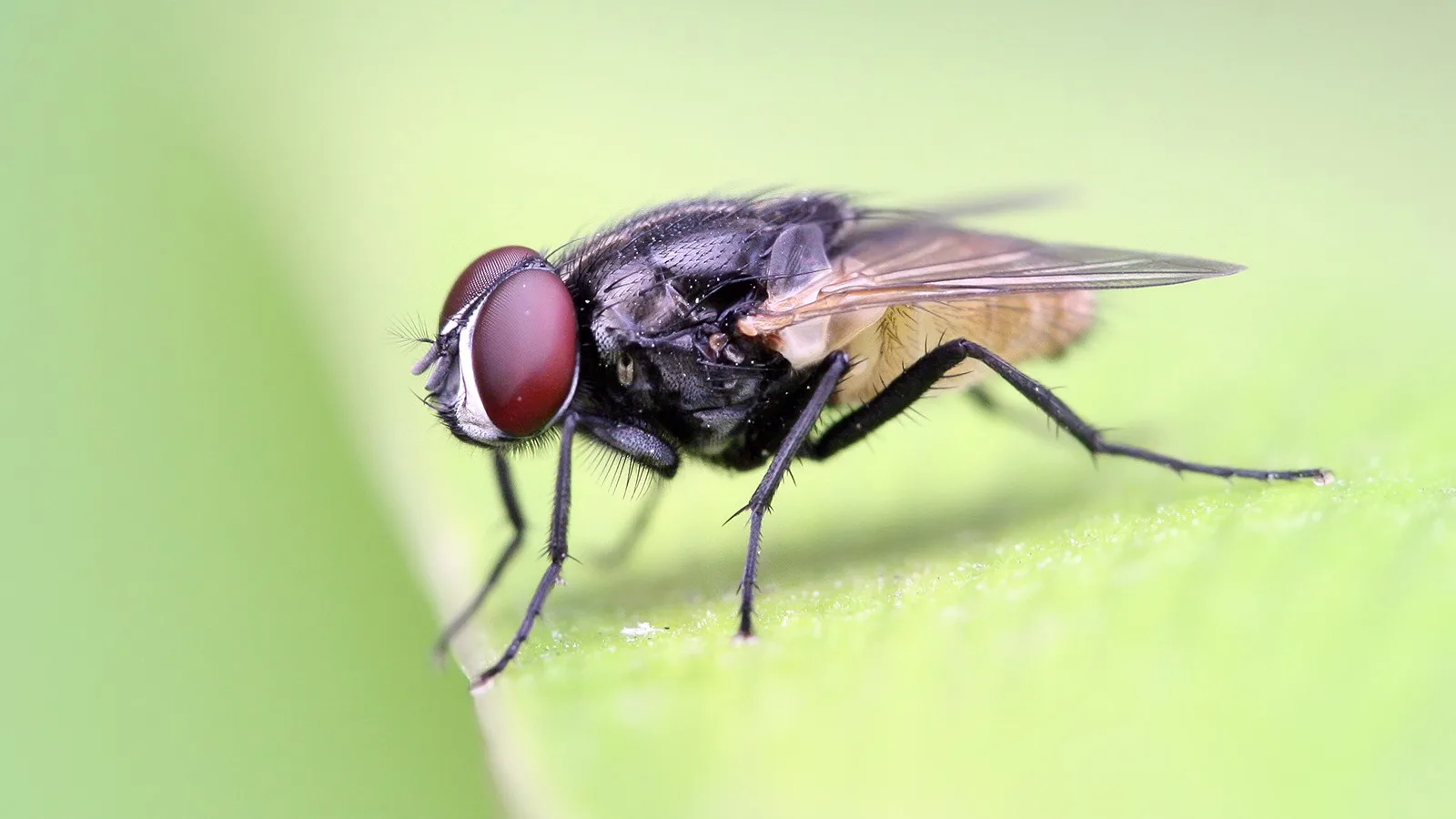
You have probably heard it said that a housefly lives for only 24 hours. It turns up in trivia lists, school textbooks and forwarded messages, and it even made it into a Pixar film. It is false. An adult housefly lives for weeks, not a day, and the insect that really does live for about a day is a mayfly, a completely different creature. Verdict: False.
The claim
The claim is simple: a housefly lives for only 24 hours. It sounds plausible because houseflies seem to appear and vanish quickly, and because most people never watch one for long enough to find out. The line was popularised further by the 1998 Pixar film A Bug's Life, in which a disgruntled housefly exclaims, "I've only got 24 hours of living, and I ain't gonna waste 'em here!"
The idea has stuck around for decades. It is comforting, too: if a fly in the kitchen dies by tomorrow anyway, there is no need to do anything about it. That comfort is exactly the problem, because a housefly that is allowed to stay can keep coming back to your food for a month.
How long houseflies really live
An adult common housefly, Musca domestica, typically lives for 15 to 30 days. Entomologists put the usual adult lifespan at 15 to 25 days, with females living about 25 days and males about 15 days. In cooler conditions, with plenty of food, houseflies have been documented living for up to 30 to 60 days.
The adult stage is only the last part of the story. A housefly goes through four stages: egg, larva, pupa and adult. The eggs hatch within 8 to 24 hours. The larvae, known as maggots, feed for 3 to 7 days. The pupal stage lasts 3 to 6 days. According to the World Health Organization, the whole journey from egg to adult takes 6 to 42 days, and in warm summer conditions it can be completed in as little as 7 to 10 days. The total lifespan from egg to death is about 28 to 30 days.
A housefly also makes the most of those weeks. A single female can lay up to 500 eggs in her lifetime, in several batches, which is why a few flies in summer can turn into a visible infestation within days. Without food, an adult housefly survives only two to three days, and without water it dies within about 48 hours. Temperature is the biggest factor: warmth speeds up the fly's metabolism and shortens its life, while cooler conditions stretch it out.
Where the 24 hours comes from
The 24-hour figure belongs to a real insect, just not the housefly. Mayflies, after spending one to three years underwater as nymphs, emerge as winged adults with one job only: to reproduce. Most adult mayflies live for one to 24 hours, and they do not even have functional mouthparts, so they cannot eat at all.
The mayfly's name gives the game away. Mayflies belong to the order Ephemeroptera, from a Greek word meaning living a day, because the adults usually live between one and four days. The record for the shortest adult life of any insect belongs to the female of the mayfly Dolania americana, which lives for less than five minutes after her final moult, just long enough to mate and lay her eggs, according to the University of Florida's Book of Insect Records.
The confusion is easy to understand. More than 120,000 species of flies exist in the world, and the word fly is used loosely for all of them. Mayflies emerge in huge swarms over rivers and lakes, and the whole swarm is dead within a day, which is a memorable sight. Houseflies, by contrast, live quietly in homes and kitchens for weeks, and nobody keeps count. The short life of one insect got attached to the name of another.
Verdict: False
Houseflies do not live only 24 hours. Adult houseflies live 15 to 30 days, and the full life cycle from egg to death takes about a month. The 24-hour lifespan belongs to mayflies, a different order of insect entirely, whose adults emerge only to mate and die. So the next time a fly is buzzing around your kitchen, do not wait for it to die by tomorrow. It has weeks left, and it will keep travelling between bins, drains and your food for all of them.
Frequently Asked Questions
How long do houseflies live?
Adult houseflies typically live 15 to 30 days, with females living about 25 days and males about 15 days. In cooler conditions with plenty of food, they can live up to 30 to 60 days. The full life cycle from egg to death takes about 28 to 30 days.
Which insect really lives for only 24 hours?
The mayfly. After one to three years underwater as nymphs, adult mayflies emerge, mate and die within about a day. Most species have no functional mouthparts and cannot eat. The female of the mayfly Dolania americana lives for less than five minutes as an adult, the shortest adult life of any known insect.
Why do people think houseflies live only a day?
The 24-hour lifespan of the mayfly got mixed up with the housefly, because both are called flies and mayflies die in huge visible swarms within a day. The idea was also spread by popular culture, including a line in the Pixar film A Bug's Life in which a housefly says it has only 24 hours to live.
Read More: Myths and Facts: A Duck's Quack Does Echo, Science Shows
Read More: Myths and Facts: Chameleons Do Not Change Colour to Match Their Background
Read More: Myths and Facts: Cows Do Not Have Four Stomachs at All
Read More: Myths and Facts: Bats Are Not Blind, They Can See Well

Comments
Be the first to comment on this story.