


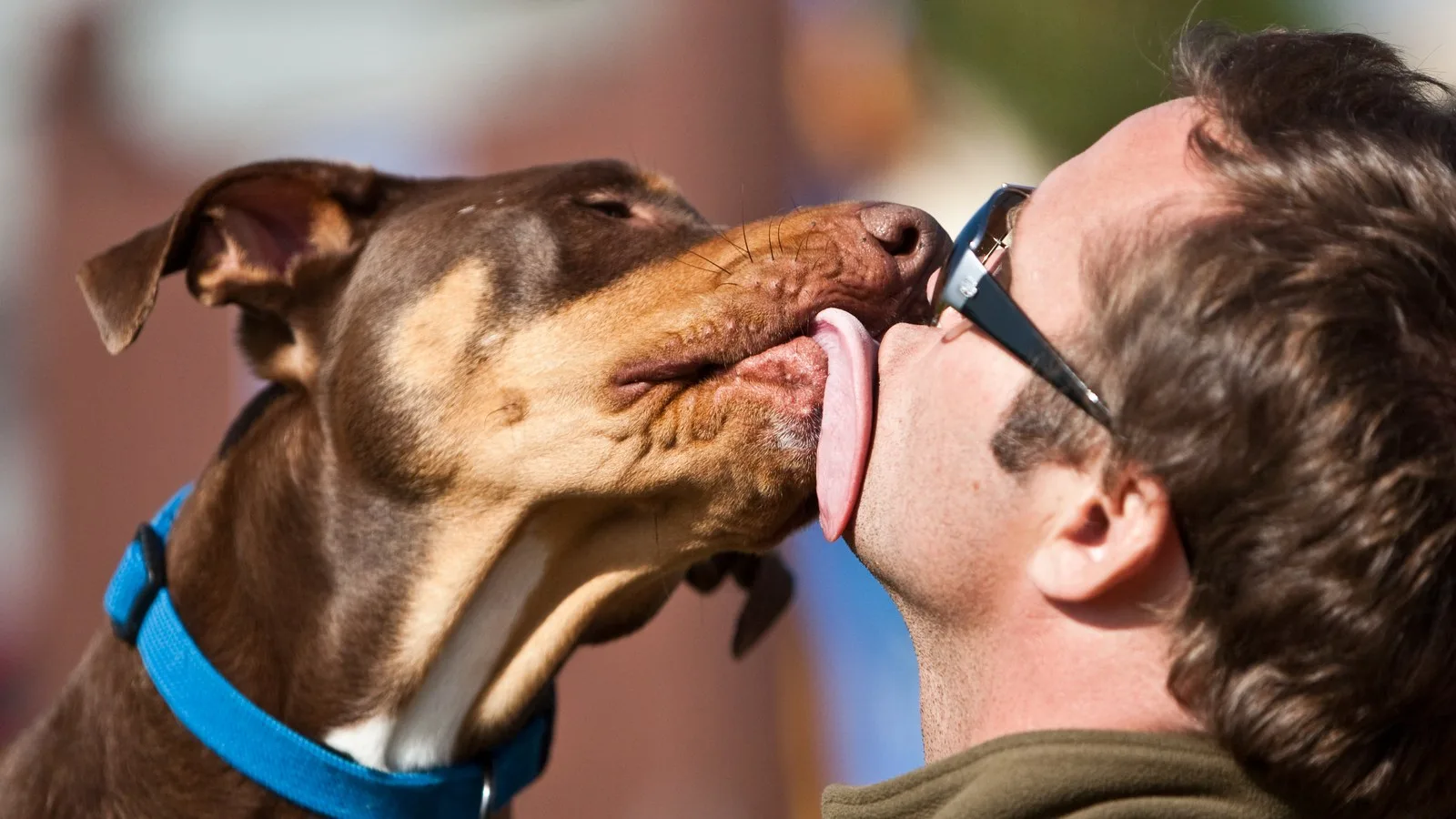
Let a dog lick your face and someone nearby will smile and say a dog's mouth is cleaner than a human's. It sounds reassuring, and it is also wrong. A dog's mouth is not cleaner than a human's. Both mouths are full of bacteria, and some of the germs in a dog's mouth can make people seriously ill. Verdict: False.
The claim
The claim is usually stated as a plain fact: a dog's mouth is cleaner than a human's mouth, so a lick is harmless and dog saliva can even help a wound heal. The reasoning goes that dogs lick their own wounds and seem to recover, they rarely pass infections to each other, and their mouths must therefore be cleaner than ours, no matter how often we brush and floss.
The idea has been repeated for so long that many owners let their dogs lick their faces, their children's faces and even open cuts without a second thought. It is a comforting belief, but the science behind it does not hold up.
Both mouths are full of bacteria
The first problem with the claim is that both mouths are teeming with microbes. Researchers have identified more than 600 types of bacteria in dogs' mouths and more than 615 types in human mouths, according to figures cited by veterinary experts. A 2020 study noted by PetMD found that dogs and humans carry similar numbers of bacteria in their mouths, but the species of bacteria are largely different.
Colin Harvey, a professor of surgery and dentistry at the University of Pennsylvania's School of Veterinary Medicine, calls the comparison itself meaningless. "It's like comparing apples and oranges," he told Live Science, because both mouths are full of germs and in many cases the bacteria in a dog's mouth differ from those in a human's. Dr Jamie Richardson, a veterinarian and chief medical officer at Small Door Veterinary, puts it the same way: both human and dog mouths contain bacteria, but neither is inherently cleaner than the other.
The bacteria even differ by species. Porphyromonas, a family of bacteria known for causing periodontal disease, comes in two forms: P. gingivalis lives in human dental plaque, while its sibling P. gulae lives in dogs. Both attack the gums and loosen teeth. The most common bacterium in a dog's mouth is Pasteurella canis, a frequent cause of infected dog bites in people.
Why dogs seem to heal by licking
Part of the myth comes from watching dogs lick their wounds and recover. Dogs do lick injuries instinctively, and saliva contains some compounds that play a role in healing. But a dog's own wound healing says nothing about whether its saliva is clean for a human wound.
Licking can also reopen a wound, strip away new tissue and push bacteria into it. That is why vets fit dogs with protective collars after surgery, to stop them licking the stitches. If dog saliva were truly clean and healing, no collar would be needed.
The germs that can hurt people
Some bacteria in a dog's mouth are dangerous to humans. The best known is Capnocytophaga canimorsus, a bacterium naturally present in the saliva of dogs and cats. It is harmless to the animal, but if it enters a person's bloodstream through a bite, or through a dog licking an open wound, it can cause severe infection and blood poisoning. Cases are rare, but documented ones have been fatal, especially in people with weak immune systems.
Dogs also use their mouths to explore the world in ways humans do not. They lick, chew and eat things they find, and drink from puddles and streams. A dog that has raided a litter box can pick up faecal bacteria such as E. coli or Salmonella, which can cause stomach illness in people. PetMD notes that a dog's mouth is only as clean as the last thing it put in it.
Human mouths, by contrast, are often in better shape simply because people get more consistent oral care: brushing, flossing and professional dental cleanings. Dogs get far fewer cavities, only about 5 percent of dogs compared with up to 90 percent of schoolchildren worldwide, according to a 2003 World Health Organization report. But the reason is that the main cavity bacterium, S. mutans, needs an acidic home, and a dog's mouth is more alkaline than a human's. Fewer cavities does not mean fewer germs overall.
Verdict: False
A dog's mouth is not cleaner than a human's mouth. Both carry hundreds of types of bacteria, and the comparison itself is meaningless because the species differ. Dog saliva is not antiseptic, and some of its bacteria can cause serious infection in people. The sensible rule is simple: enjoy your dog's affection, but do not let it lick an open wound, and wash with soap and water if it does.
Frequently Asked Questions
Is a dog's mouth cleaner than a human's mouth?
No. Researchers have found more than 600 types of bacteria in dogs' mouths and more than 615 types in human mouths, and the species are largely different. Veterinary experts say neither mouth is inherently cleaner than the other, and comparing them is like comparing apples and oranges.
Can dog saliva make you sick?
Yes, though serious illness is rare. Dog saliva can carry Capnocytophaga canimorsus, which can cause severe infection if it enters the bloodstream through a bite or a lick on an open wound. Dogs can also pick up E. coli and Salmonella from things they eat or lick. Wash any wound a dog has licked with soap and water and see a doctor if it becomes red, swollen or painful.
Should I let my dog lick my face?
A lick on healthy skin is low risk for most people, but it is best not to let a dog lick your face, mouth or any open cut. People with weak immune systems should be extra careful. If a dog licks a wound, clean it thoroughly with soap and water.
Read More: Myths and Facts: Dogs Do Not See Only in Black and White
Read More: Myths and Facts: Bats Are Not Blind, They Can See Well
Read More: Myths and Facts: Chameleons Do Not Change Colour to Match Their Background
Read More: Myths and Facts: Cows Do Not Have Four Stomachs at All

Comments
Be the first to comment on this story.