


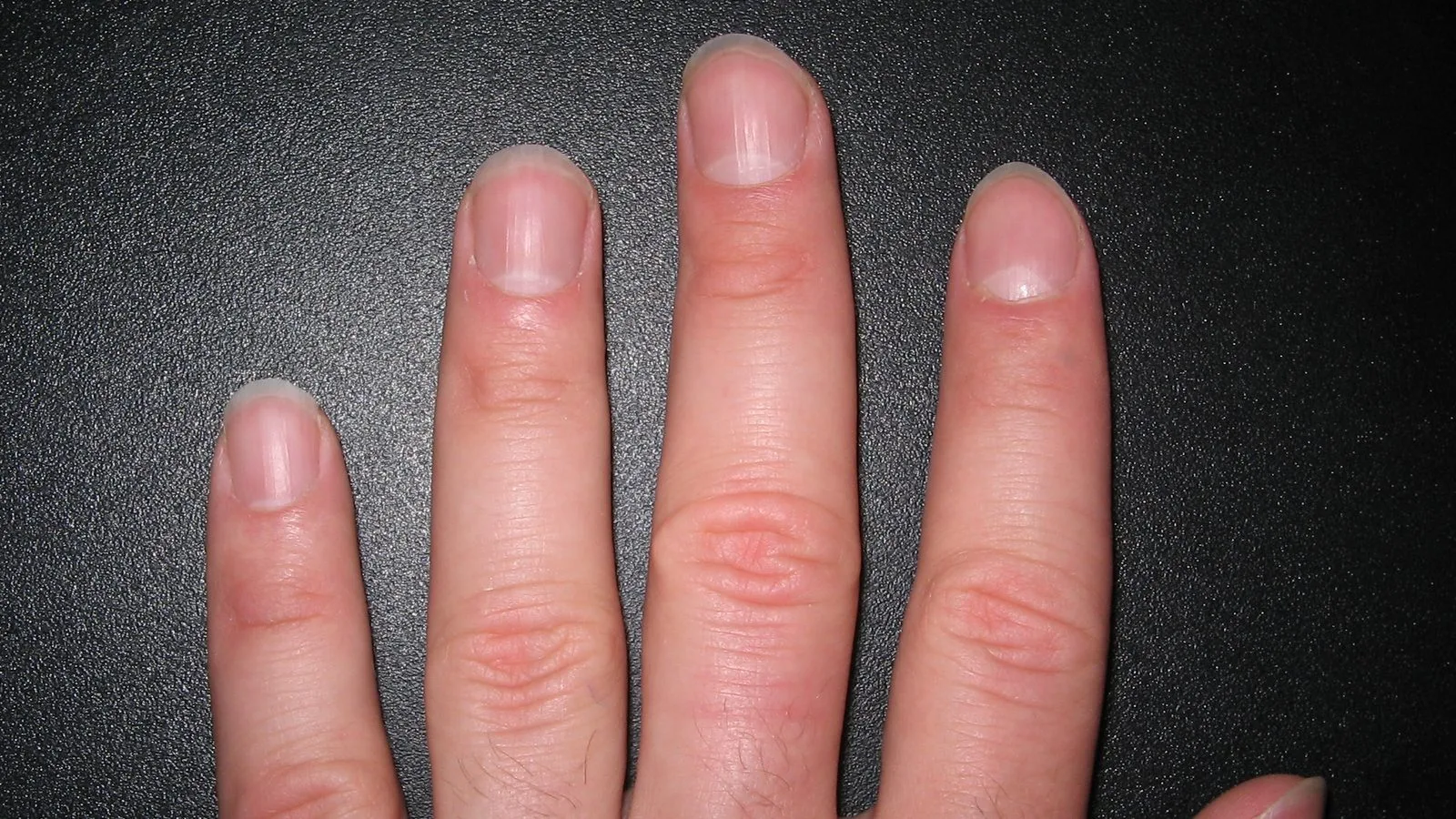
Your hair and fingernails keep growing after you die. It is one of the oldest beliefs about dead bodies, repeated in novels, films and funeral parlours for a century. It is also completely false. Growth stops the moment the heart stops, and what looks like growth is the rest of the body shrinking. Verdict: False.
Why growth stops when the heart stops
Hair and nails are built by living cells that need a constant supply of fuel. A hair grows from a follicle, a tiny pocket of fast dividing cells at the base of each shaft, fed by a loop of capillaries. Fingernails grow from the nail matrix, a band of similar cells hidden under the skin at the base of the nail. Both are among the most metabolically active tissues in the body.
In life, fingernails advance about 0.1 millimetres a day, roughly 3.5 millimetres a month, and hair grows about 0.3 millimetres a day. That growth is an active, energy hungry process. The cells divide, fill with keratin, the tough protein that makes hair and nail, and die in a controlled way to become the visible shaft or plate. Every step needs glucose and oxygen delivered by circulating blood.
When the heart stops, that supply ends within minutes. Dermatologist Dr Doris Day told Live Science that once the body dies there is no more glucose, so skin, hair and nail cells no longer turn over and produce new cells. A 2007 review in the medical journal The BMJ, which tested common medical myths, reached the same conclusion: hair and nail growth are active processes that require live cells, so they cannot continue after death. The factory loses power, and nothing new is made.
Why it looks like growth
The illusion is real, and it fooled observers for centuries, including doctors. After death the body steadily loses water through evaporation from the skin. As the skin and the tissue beneath it dry out, they shrink and pull back.
Around a hair, the drying scalp retracts and exposes a length of shaft that was previously hidden below the surface, so stubble looks longer. Around a fingernail, the skin at the base pulls back and the nail plate appears to lengthen. The hair and the nail have not moved at all. The envelope around them has shrunk.
Mortician and author Caitlin Doughty put it plainly in a Britannica video: it is not that the hair and nails are growing, it is that the rest of the body is shrinking, as the once plump, moisturised skin shrivels and reveals what was already there.
BBC science writer Claudia Hammond adds two details that make the illusion stronger. Drying skin on the face pulls back towards the skull, making stubble stand out, and goosebumps caused by the contraction of the tiny muscles around each hair can add to the effect. The result looks exactly like growth to the naked eye, which is why the belief survived so long.
Where the idea came from
The belief is ancient, but one book did more than most to spread it. Erich Maria Remarque's 1929 novel All Quiet on the Western Front, about German soldiers in the First World War, includes a scene in which a character says a dead comrade's hair and nails kept growing. Millions read the book, and the line stuck.
It also survived because it is hard to disprove by looking. Nobody watches a body closely enough, hour by hour, to see that the change is shrinkage, not growth. No measurement has ever found postmortem lengthening, yet the image of a corpse quietly growing its nails is too vivid to die.
The myth also fits a wider unease about death: the idea that some part of us keeps going after the rest has stopped. It does not. The cells that build hair and nails are among the first to lose their supply lines, because they divide so fast and need so much energy.
Verdict: False
Hair and fingernails do not keep growing after death. Growth is an active process that needs circulating blood, glucose and oxygen, and all three stop when the heart stops. What people have seen for centuries is dehydration: the skin dries, retracts and exposes more of the hair shaft and nail plate, creating the illusion of growth. The hair and nails themselves never lengthen by even a millimetre after death.
Frequently Asked Questions
Do fingernails grow after death?
No. Fingernails grow about 0.1 millimetres a day in life, from cells in the nail matrix that need glucose and oxygen from circulating blood. Once the heart stops, those cells stop dividing. The skin around the nail dries and pulls back, which makes the nail look longer, but the nail itself does not grow.
Why do dead bodies look like their hair has grown?
Because the skin shrinks. After death the body loses water, the scalp dries and retracts, and more of each hair shaft is exposed. BBC science writer Claudia Hammond notes that drying skin pulls back towards the skull, making stubble look more prominent, and goosebumps from contracting hair muscles add to the effect.
Is there any scientific study on this?
Yes. A 2007 review in the medical journal The BMJ tested the claim as one of several common medical myths and found it false: hair and nail growth require live cells and cannot continue after death. The Indian Journal of Medical Ethics lists it the same way, noting that dehydration and skin retraction create only the appearance of growth.
Read More: Myths and Facts: You Do Not Swallow Eight Spiders in Your Sleep Each Year
Read More: Myths and Facts: Swallowed Chewing Gum Does Not Stay Seven Years
Read More: Myths and Facts: Humans Have More Than Five Senses
Read More: Myths and Facts: Cold Weather Does Not Cause Colds
Comments
Be the first to comment on this story.