


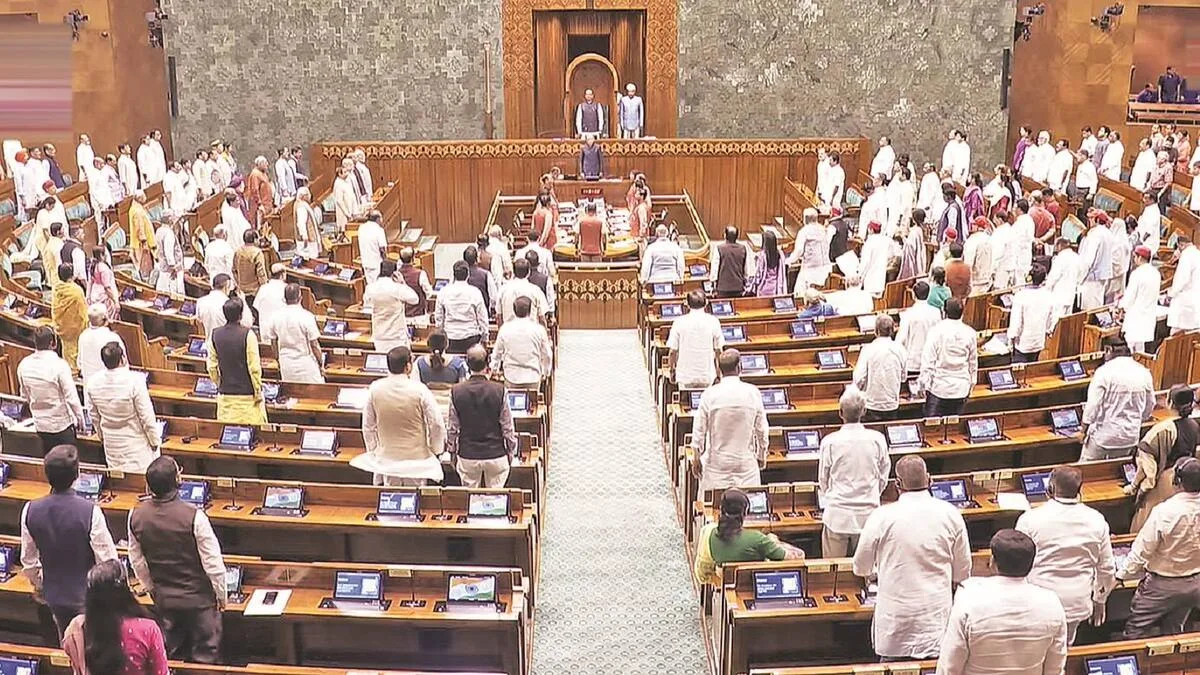
The Union Cabinet on Friday cleared a fresh bill that links women's reservation in Parliament to a delimitation exercise, proposing a uniform 50 per cent increase in Lok Sabha seats for every state. It is the government's second attempt to pass the legislation after an earlier version was defeated in April, and it comes days before a special sitting of Parliament.
The revised proposal answers the biggest objection to delimitation: that states which controlled population growth, mostly in the south, would lose seats to faster growing states. By raising every state's seats by the same proportion and freezing each state's share until 2051, the bill protects every state's representation while creating room for the 33 per cent women's quota.
What is delimitation?
Delimitation is the redrawing of Lok Sabha and state assembly constituency boundaries and the allocation of seats based on population changes. In India, an independent Delimitation Commission carries out the exercise under Articles 81, 82 and 170 of the Constitution.
Its purpose is to keep constituency populations broadly equal and to update seats reserved for Scheduled Castes and Scheduled Tribes. The allocation of Lok Sabha seats among states has been frozen on the basis of the 1971 Census for decades.
What does the fresh bill propose?
The fresh legislation, the Delimitation (Second) Bill, 2026, was issued on November 27 as Bill No 159 of 2026. Its key proposals, as reported, are a uniform 50 per cent increase in Lok Sabha seats for every state and Union Territory, and the same increase for state legislative assemblies. The Lok Sabha's strength would rise from the present 543 elected seats to a maximum of 850 through delimitation.
Each state's existing share of Lok Sabha seats would be frozen until 2051, so no state loses representation relative to other states. The 2011 Census, the latest published Census, would be used to redraw constituencies, and a Delimitation Commission would be set up to carry out the exercise.
The Cabinet meeting was chaired by Prime Minister Narendra Modi at 1 pm at Sewa Teerth. The government is expected to introduce the legislation in the Lok Sabha on November 30, the first day of the special sitting.
How does it fast-track women's reservation?
The Constitution (106th Amendment) Act, 2023, known as the Nari Shakti Vandan Adhiniyam, introduced reservation of one third of seats in the Lok Sabha and state assemblies for women. But the quota was linked to the first Census after the Act came into force, followed by delimitation, which pushed implementation beyond the 2027 Census.
The fresh bill seeks to remove that wait. It proposes amending Article 334A, which governs women's reservation, so the quota can take effect after a delimitation exercise based on the latest published Census figures, which are currently from 2011. The aim is to have the 33 per cent reservation in place before the 2029 Lok Sabha elections. Seats reserved for women would be allotted by rotation to different constituencies, and the reservation would remain in force for 15 years unless extended by Parliament.
What happened last time?
The government introduced a similar package in April 2026. The Constitution (131st Amendment) Bill, 2026, proposed raising the Lok Sabha's maximum strength to 850 and implementing women's reservation, but it did not include the uniform 50 per cent increase for every state.
On April 17, the bill was defeated in the Lok Sabha. Of the 528 members present and voting, 298 voted in favour and 230 opposed it. A constitutional amendment needs a special majority of at least two thirds of members present and voting, so the bill needed 352 votes and fell short by 54.
The numbers game this time
In the current 543-member Lok Sabha, the two thirds mark would be 362 if all members were present and voting. The ruling National Democratic Alliance has 320 members, so it needs opposition support.
Since April, 26 MPs have moved out of the opposition camp. Twenty rebel Trinamool Congress MPs broke away and merged with the Nationalist Citizens Party of India, pledging support to the NDA. Six Shiv Sena (UBT) MPs joined the Eknath Shinde-led Shiv Sena. The Shiromani Akali Dal's lone MP is also expected to vote with the government, and the YSR Congress is reportedly set to extend support with its four MPs.
Two parties could still decide the outcome. The DMK, with 22 MPs, has said it would consider supporting the bill if Tamil Nadu's existing share of representation is protected. The NCP (Sharadchandra Pawar), with eight MPs, has said it will decide after examining the proposed legislation. The opposition INDIA bloc is scheduled to meet on Saturday to discuss its strategy.
What happens next
Parliament will reconvene for a special sitting from November 30 to December 3. The Lok Sabha will meet on November 30 and December 1, and the Rajya Sabha on December 2 and 3. The sitting is an extension of the Monsoon Session, which was adjourned sine die on August 13 but was not prorogued, which allows Parliament to reconvene at short notice.
The Congress has opposed the bill, calling it politically motivated and unilateral and saying it threatens India's federal structure. The party has also criticised the short-notice sitting without Question Hour or Zero Hour. Congress leader Jairam Ramesh alleged that the gap since August had been used for "Operation Lotus" to gather the numbers needed to pass the legislation.
Parliamentary Affairs Minister Kiren Rijiju, who announced the special sitting on November 26, has said the government will introduce the bill in the Lok Sabha on November 30 and has urged opposition parties to take part in the debate.
Frequently Asked Questions
What is the delimitation bill proposing?
A uniform 50 per cent increase in Lok Sabha and state assembly seats for every state, using the 2011 Census, with each state's share of seats frozen until 2051, to make room for 33 per cent reservation for women.
How many Lok Sabha seats would there be?
The Lok Sabha's strength would rise from the present 543 elected seats to a maximum of 850 through delimitation, with every state gaining seats in the same proportion.
When will women's reservation take effect?
The bill aims to bring the 33 per cent women's quota into force after the delimitation exercise, in time for the 2029 Lok Sabha elections, without waiting for the 2027 Census.
Read More: Explained: Tata Trusts vs Chandrasekaran, the Article 121 Fight Over His Reappointment
Read More: Explained: SC Orders Red Hexagon Warnings on High Sugar, Salt and Fat Foods
Read More: Explained: West Bengal SIR, the Supreme Court Order on 38 Lakh Voter Appeals
Read More: Explained: US Section 301 Tariffs on India, the 25% Proposal and the 17% Deal Rate
Comments
Be the first to comment on this story.