


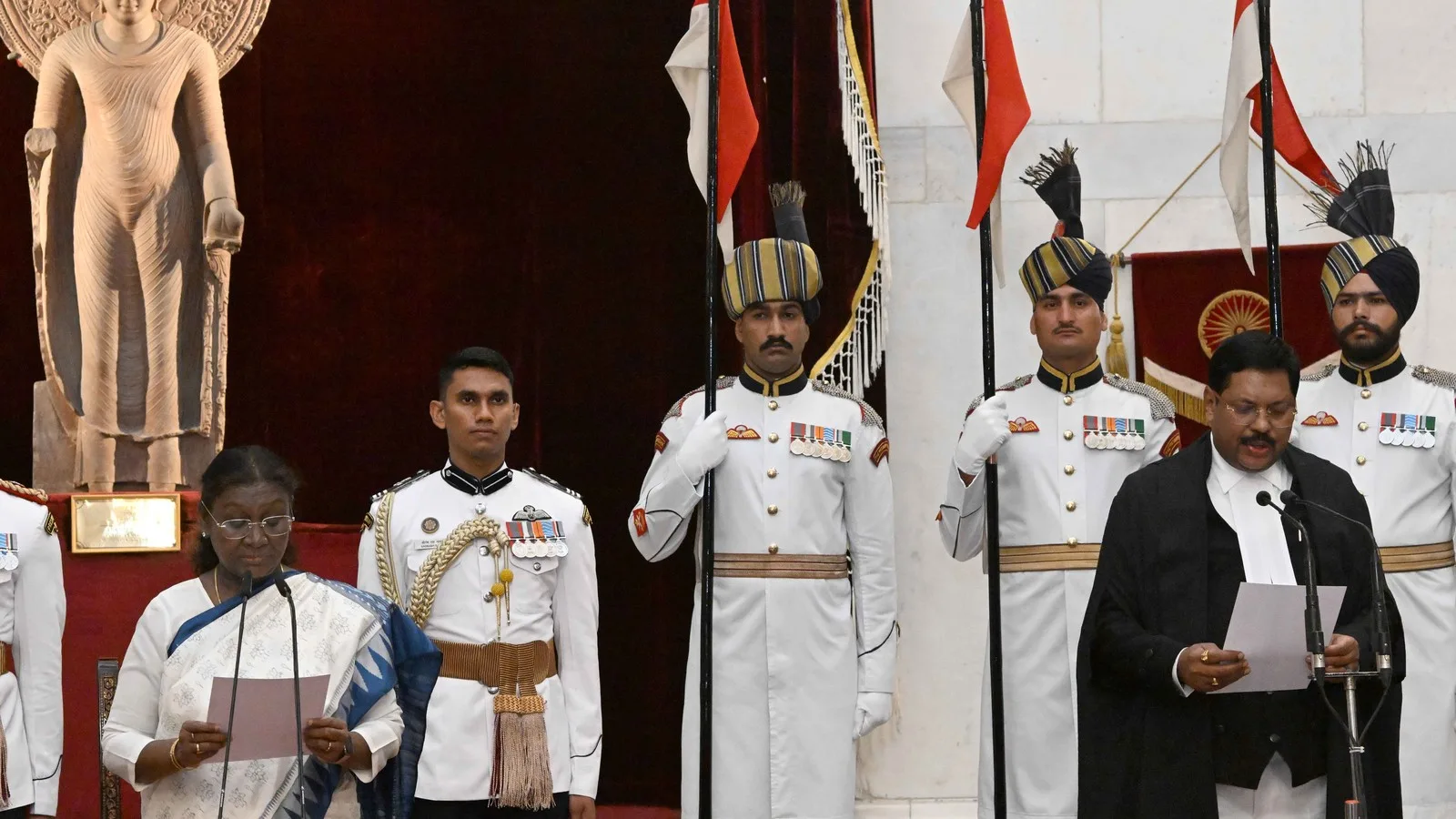
Former Chief Justice of India B.R. Gavai has written to President Droupadi Murmu with an unusually blunt complaint about how judges are picked for the higher judiciary. In a three-page letter sent on Friday, 27 November, he alleged that recent recommendations of the Supreme Court Collegium show a "complete disregard to principles of merit and inclusivity" and favour candidates from "one particular section of the society". Here is what the letter says, and how judges are appointed in India.
What the letter says
Justice Gavai wrote that candidates from one particular section are being favoured for recommendation and elevation "to the exclusion of everyone else including marginalised communities including Scheduled Castes, Tribes, Other Backward Classes, minorities, women and even persons from forward sections of the society who are not from a particular community". He did not name the community he says is being favoured.
He said he was "constrained to voice my dissent and disappointment" and that there are "compelling circumstances which support the perception that increasingly recommendations are being made with a focus on appeasing and rewarding a single community". Copies went to Prime Minister Narendra Modi and Union Law Minister Arjun Ram Meghwal.
The numbers Gavai cited
Justice Gavai said a community accounting for less than 5 per cent of India's population has had more than 40 per cent representation in the Supreme Court in the recent past, and that this share has "risen manifold".
He quoted government data placed before Parliament by Law Minister Arjun Ram Meghwal in the Rajya Sabha in March 2025. Of the 715 high court judges appointed since 2018, only 22 belonged to the Scheduled Castes, 16 to the Scheduled Tribes, 89 to the Other Backward Classes and 37 to minority communities.
He said roughly three out of every four judges in the constitutional courts belonged to the general category. For appointments made between January 2021 and January 2026, the share of forward communities was close to 80 per cent, while the Other Backward Classes, an estimated 40 to 50 per cent of the population, received under 14 per cent representation. He also flagged that caste is not recorded for Supreme Court appointments at all, and said that silence is itself part of the problem.
The examples he gave
To support his charge, Justice Gavai cited instances of transfers and appointments, without naming the judges involved. In one case, he said a high court Chief Justice was transferred from one high court to a smaller high court, then to one of the smallest high courts in the country, and was then "rewarded, for being from a particular community, by transfer to a prominent High Court".
At the same time, he said a meritorious and hardworking Chief Justice of a high court was transferred to a smaller high court to make way for him, a move he said is "not only demoralising for such a meritorious Chief Justice but also has a chilling effect on all hard-working judges, including persons belonging to a marginalised section of the society".
In another instance, he said a judge was transferred from his parent high court to another high court on punitive consideration and was later rewarded with appointment as Chief Justice of a large and prominent high court.
The letter came days after the Collegium recommended transferring Tripura High Court Chief Justice M.S. Ramachandra Rao to the Karnataka High Court, with a matching proposal to move Karnataka Chief Justice Vibhu Bakhru to the Jharkhand High Court.
Who B.R. Gavai is
Justice Gavai was the 52nd Chief Justice of India. He was sworn in on 14 May 2025 and retired in November 2025, and was succeeded by Chief Justice Surya Kant. He was the first Buddhist and the second Dalit, after K.G. Balakrishnan, to head the Indian judiciary.
He said the disturbing trend began in the "recent past" and not while he was part of the Collegium. "When I was a part of the collegium and was Chief Justice of India, I always followed the principles of diversity and inclusion," he wrote.
He also accepted a share of the blame for the long term pattern. "Each of us bears some share of that failure, and I say so plainly. It is because I know how such patterns persist through familiarity, through networks, and through unexamined ideas of who 'looks like' a Supreme Court judge, that I can no longer stay silent," he wrote.
How judges are appointed in India
Judges of the Supreme Court and the high courts are picked by the Collegium, a body of the five senior-most Supreme Court judges headed by the Chief Justice of India. For high court appointments, the Collegium is the Chief Justice plus the two senior-most judges, acting in consultation with the Chief Justice of the high court concerned.
The President formally appoints the judges, for the Supreme Court under Article 124(2) of the Constitution and for the high courts under Article 217. The Collegium's recommendations became decisive through Supreme Court judgments over the past three decades, even though the Constitution itself does not mention the Collegium.
The government can send a recommendation back once for reconsideration. If the Collegium reiterates the name, the government must appoint the judge. Parliament tried to replace the system with the National Judicial Appointments Commission in 2014, but the Supreme Court struck the commission down in 2015 and the Collegium system returned.
What the President can and cannot do
Justice Gavai's constitutional argument is that Article 124(2) vests the power to appoint Supreme Court judges in the President. He said the judicial interpretation that made Collegium recommendations decisive "has not made the collegium unaccountable, nor it has relieved your high office of the President of the constitutional duties" that the Article casts on her.
He questioned whether the Collegium's primacy in appointments could place it beyond accountability. In practice the President acts on the advice of the Council of Ministers, so the letter is a request for intervention, not an order.
What happens next
The letter puts the composition of the higher judiciary in public debate as the Collegium makes fresh recommendations for the Supreme Court and the high courts. What to watch is whether the coming recommendations show a change in the balance of communities represented, and whether the government or the Collegium responds.
Frequently Asked Questions
What is the Collegium?
The Collegium is the body of the five senior-most Supreme Court judges, headed by the Chief Justice of India, that recommends names for appointment as judges of the Supreme Court and the high courts. The system was created by Supreme Court judgments, not by the Constitution.
What did Justice Gavai allege?
He alleged that recent Collegium recommendations favoured candidates from one particular community at the cost of merit, diversity and inclusivity, and that Scheduled Castes, Scheduled Tribes, Other Backward Classes, minorities and women were being excluded. He did not name the community.
Can the President overrule the Collegium?
No, not on her own. The President formally appoints judges under Article 124(2), but acts on the advice of the Council of Ministers. The government's only formal tool is to return a recommendation once for reconsideration; if the Collegium reiterates the name, the government must appoint the judge.
Read More: Explained: Delimitation Bill and the Women's Quota Push
Read More: Explained: Constitution Day, Why November 26 Is Samvidhan Divas
Read More: Explained: West Bengal SIR, the Supreme Court Order on 38 Lakh Voter Appeals
Read More: Explained: The Thiruparankundram Deepam Row and the Supreme Court Order


Comments
Be the first to comment on this story.