


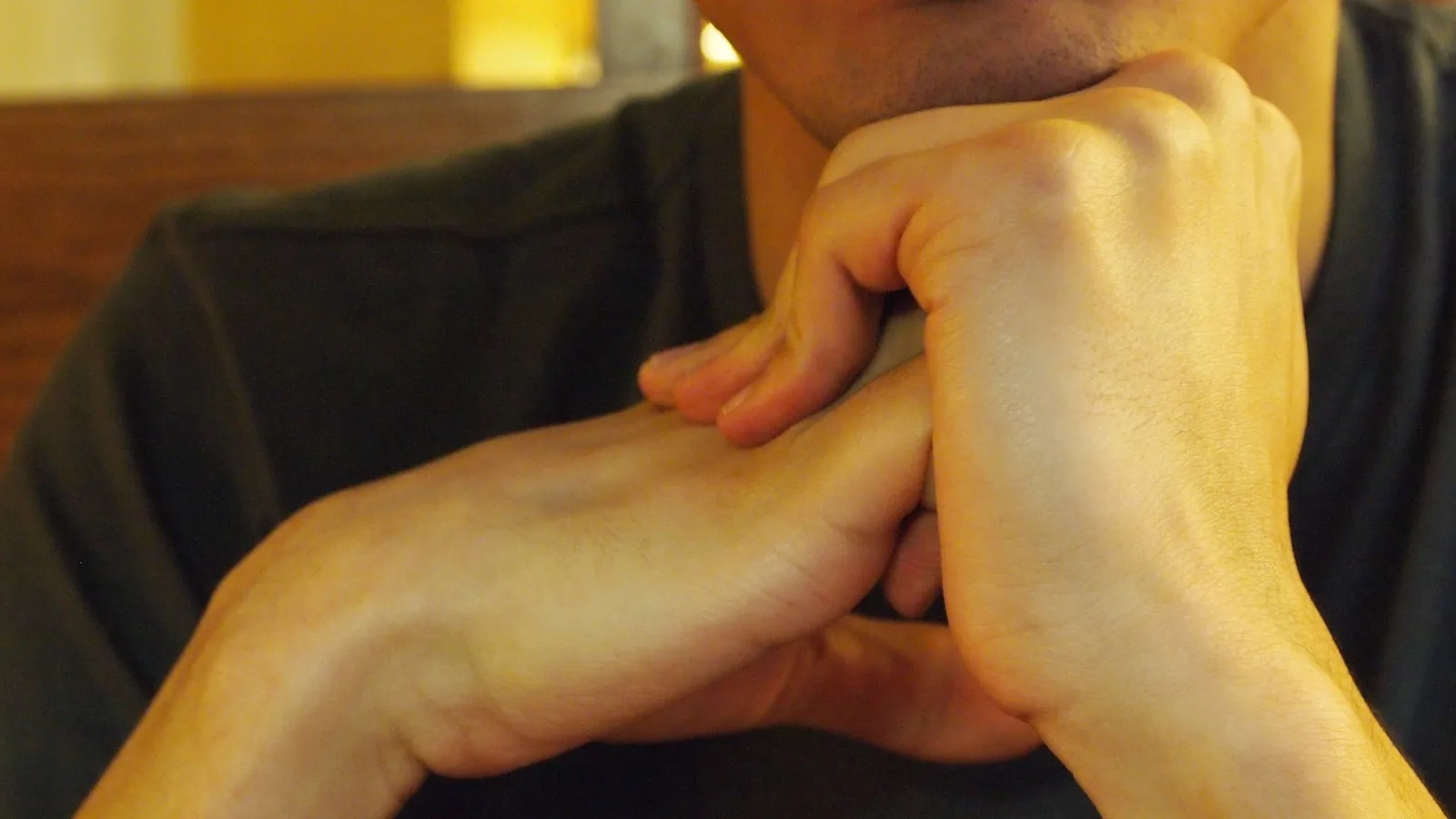
If you crack your knuckles, someone has probably warned you that you will get arthritis. The warning has been passed down for generations, and it still makes people stop mid-crack. It is also wrong. Cracking your knuckles does not cause arthritis, and decades of research have found no link between the habit and the disease. Verdict: False.
The claim
The claim is simple: the popping sound is your bones grinding or your cartilage snapping, and doing it often enough wears the joint out until arthritis sets in. But the sound is not bones grinding, and the joint is not being worn out. The pop comes from the fluid inside the joint, not from the bones at all.
What makes the cracking sound
Each knuckle is surrounded by a capsule filled with synovial fluid, a thick liquid that lubricates the joint. The fluid contains dissolved gases. When you pull or bend a finger to crack it, you stretch the joint and increase the space inside the capsule. The pressure inside drops suddenly, and the dissolved gas comes rapidly out of solution and forms a small cavity, or bubble, in the fluid.
Scientists once thought the sound came from the bubble collapsing. A 2015 study settled it by filming fingers being cracked in real time with MRI scans: researchers at the University of Alberta found the sound happens at the exact moment the gas cavity forms, not when it collapses. The process is called tribonucleation. Once a joint has popped, the gas needs about 20 minutes to dissolve back, so the same knuckle cannot be cracked again right away.
The 50-year self-experiment
The most famous evidence comes from Dr Donald Unger, a California physician who tested the claim on himself. He cracked the knuckles of his left hand at least twice a day for 50 years, an estimated 36,500 cracks, while leaving his right hand untouched.
In 1998 he published his findings as a letter in the journal Arthritis and Rheumatism: after 50 years, neither hand showed symptoms of arthritis, and there was no difference between them. The experiment later earned him the Ig Nobel Prize in Medicine in 2009. It was a study of one person, so it proves little on its own, but larger studies agree.
What larger studies found
In 2011, researchers from the Uniformed Services University of the Health Sciences examined 215 people aged 50 to 89, about 20 percent of whom cracked their knuckles regularly. Hand arthritis showed up in 18.1 percent of the crackers and 21.5 percent of the non-crackers, and the researchers concluded the chance was about the same in both groups.
A 2017 study agreed: habitual crackers had the same level of physical function as people who never cracked their joints, and ultrasound research found no loss of grip strength or cartilage thickness among people who cracked five or more times a day. Harvard Medical School says cracking your knuckles probably will not raise your risk for arthritis.
One older study did raise a flag: a 1990 study of 300 people found more hand swelling and a weaker grip among habitual crackers. That finding has not held up, and the 2017 research found no effect on grip strength. The weight of the evidence points one way: no link with arthritis.
What actually causes hand arthritis
If knuckle cracking does not cause arthritis, what does? The strongest predictors of hand osteoarthritis are age and family history. A 2017 analysis found that family history roughly tripled the risk of hand arthritis, while knuckle cracking was not a significant factor at all. As orthopaedic surgeon Dr Charles Cassidy of Tufts Medical Center puts it, a better guide to whether a young person will develop arthritis is whether their parents or grandparents had it.
The real risks of cracking your knuckles
The habit is not completely harmless. There are at least two published reports of injuries suffered while people were trying to crack their knuckles, and Harvard Medical School notes chronic cracking may be linked with reduced grip strength. If a joint locks when it pops, or if cracking brings pain or swelling, stop and see a doctor. But ordinary cracking, even done for decades, has not been shown to damage the joint.
Verdict: False
Cracking your knuckles does not cause arthritis. The pop is a gas cavity forming in the joint fluid, not bones grinding, and study after study has found no difference in arthritis rates between people who crack their knuckles and people who do not. Age and family history decide your risk, not your knuckles.
Frequently Asked Questions
Does cracking your knuckles cause arthritis?
No. Multiple studies spanning decades have found no link between habitual knuckle cracking and hand arthritis. In a 2011 study of 215 people, 18.1 percent of knuckle crackers had hand arthritis, compared with 21.5 percent of non-crackers, a difference the researchers called no difference at all.
What makes the cracking sound?
The sound comes from synovial fluid inside the joint. When you stretch the joint, the pressure drops and dissolved gas rapidly forms a cavity in the fluid. A 2015 real-time MRI study showed the sound happens at the moment the cavity forms. The gas takes about 20 minutes to dissolve back, so the same knuckle cannot pop again right away.
Can cracking your knuckles hurt your hands?
Ordinary cracking has not been shown to damage joints, but forceful cracking can injure a finger, and there are published reports of such injuries. If a joint locks, or if cracking brings pain or swelling, stop and see a doctor.
Read More: Myths and Facts: Touching a Baby Bird Does Not Make Its Mother Abandon It
Read More: Myths and Facts: A Dog's Mouth Is Not Cleaner Than a Human's
Read More: Myths and Facts: Putting Butter on a Burn Does Not Help It Heal
Read More: Myths and Facts: Touching a Toad Does Not Give You Warts


Comments
Be the first to comment on this story.