


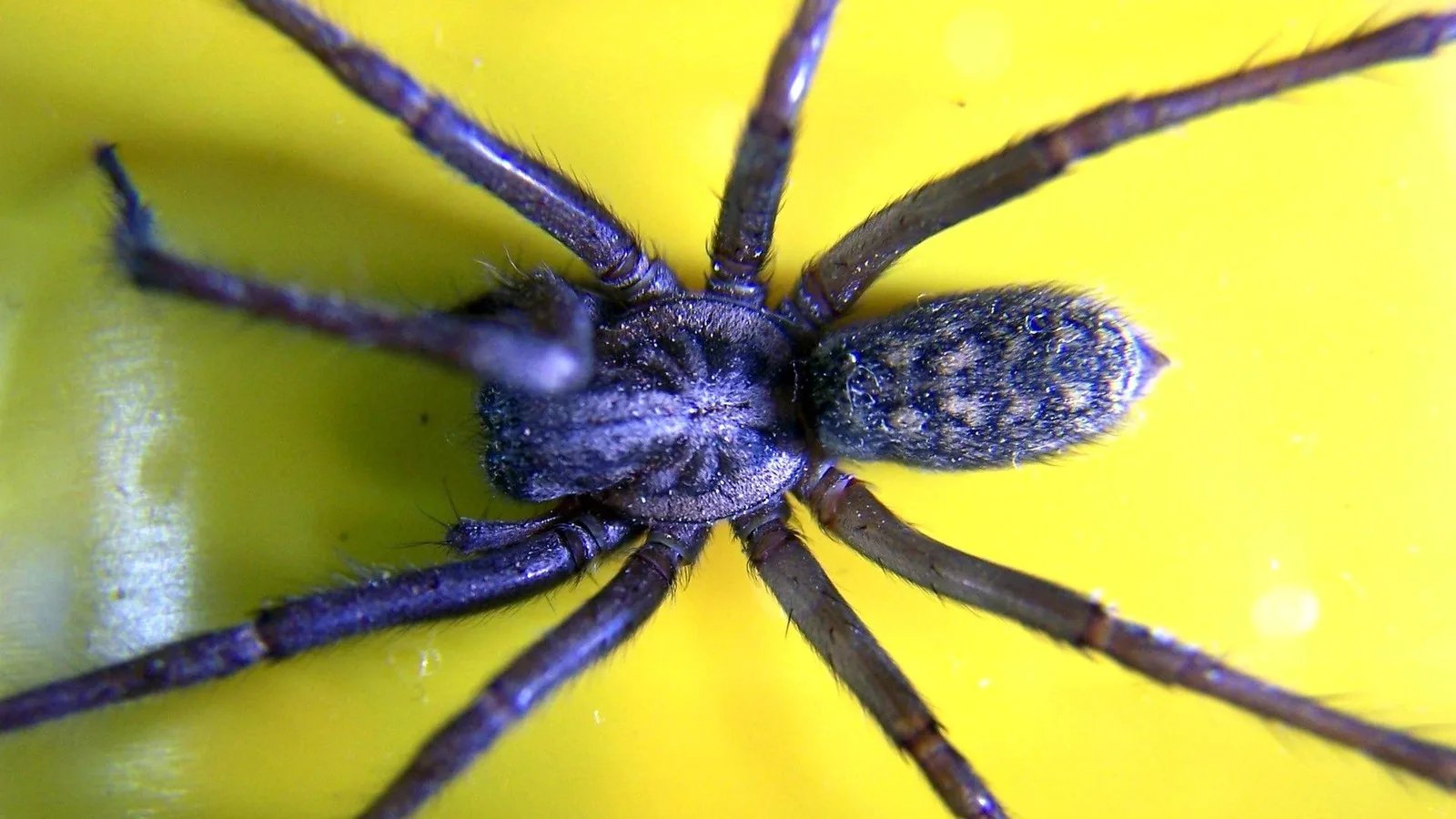
You have probably heard it at a dinner party or read it online: the average person swallows eight spiders a year in their sleep. It sounds like a fact, it has a precise number, and it is completely false. No case of a person swallowing a spider in their sleep has ever been recorded, and the experts who study spiders say it almost certainly never happens. Verdict: False.
The claim
The claim is simple and it is always told the same way. While you sleep, spiders crawl into your open mouth, and you swallow about eight of them every year. Over a lifetime that would be hundreds of spiders. The number gives the claim a scientific sound, but it is not based on any study. Nobody has ever counted spiders swallowed in sleep, because no scientist has ever found a case to count. The figure changes every time the story is told. Some versions say three spiders a year, others say eight, and some say dozens. As Rod Crawford, curator of arachnids at the Burke Museum in Seattle, has pointed out, every time you hear this story the teller has a different number and a different time period, so even if one version were correct, nearly all the tellers would still be wrong.
Why spiders stay away from you
Spiders want nothing to do with a sleeping human. A person in bed is huge, hot, noisy and constantly moving. Your heart beats, your chest rises and falls, you breathe, you roll over and you may snore. Spiders sense the world mainly through vibration, and a sleeping human is a storm of it. Crawford puts it plainly: a sleeping person is not something a spider would willingly approach. Bill Shear, a biology professor at Hampden-Sydney College in Virginia and a former president of the American Arachnological Society, says spiders regard us much like they would regard a big rock. We are so large that to a spider we are simply part of the landscape.
Only three or four spider species live in most homes, and they keep to their webs or to quiet corners, basements and attics. A bed offers a spider no prey and no shelter, so it has no reason to climb into one. And your mouth is the worst destination of all. It is warm, wet and full of carbon dioxide and water vapour, and it sits in the middle of a creature that could crush the spider by accident. Geoff Oxford, honorary secretary of the British Arachnological Society, has asked the obvious question: why on earth would a spider go in there? They just do not do that.
The chain of accidents that would have to happen
For a spider to end up swallowed, a whole chain of unlikely events would have to line up. First, you would have to be sleeping with your mouth open. Most people breathe through their nose in sleep, so their mouth stays shut. Second, the spider would have to cross your bed, climb onto your face and reach your mouth without waking you, even though the skin of your lips and tongue is extremely sensitive. Third, it would have to land at the back of your throat without touching anything on the way in. Fourth, you would have to swallow at exactly that moment. We do not swallow automatically while we sleep, and a spider on your face would almost certainly wake you first. Matt Wilkinson, a zoologist at Cambridge University, says that if a spider crawled across your face you would know about it long before it bit you, and certainly before you bit it.
Floyd Shockley, an entomologist at the Smithsonian National Museum of Natural History, says you have a better chance of winning the Powerball lottery than of having a spider fall into your mouth while you sleep. A fall from above is about the only way it could happen at all, and even that has never been documented. Crawford notes that millions of people have watched another person sleep, yet nobody has produced a single good eyewitness account of a spider climbing into a sleeper's mouth.
Where the eight spiders figure came from
Nobody knows where the claim started. For years people blamed a 1993 column in the magazine PC Professional by Lisa Holst, who supposedly invented the figure to show how readily people believe things they read online. That origin story is itself a legend. In 2001 the fact checking site Snopes deliberately cited a fake magazine article as the source of the rumour, to prove how willingly people accept a citation without checking it. The eight spiders claim is a myth about a myth, repeated so often that the repetition started to feel like proof. The fear behind it is real enough. Spiders are among the most feared animals, and arachnophobia, the fear of spiders, is thought to affect between 2.7 percent and more than 11 percent of people. Fear makes a scary claim easy to believe and easy to repeat.
The one true part
There is a small grain of truth in the story, but it is not the one people think. Tiny fragments of insects and spiders do end up in the food we eat. The United States Food and Drug Administration publishes defect levels that allow trace amounts of insect parts in foods such as flour, chocolate and peanut butter, because it is impossible to keep them out entirely. That has nothing to do with spiders crawling into your mouth at night. It is a fact about food processing, not about sleep. Spiders themselves are useful houseguests. They eat flies, mosquitoes and other pests, and less than 1 percent of spider species are potentially harmful to humans. Entomologists say that unless a spider in your home is a nuisance, the best thing to do is leave it alone.
Verdict: False
You do not swallow eight spiders a year in your sleep. You almost certainly swallow none at all. No case has ever been recorded in scientific or medical literature, and everything we know about spiders and about sleep says it does not happen. Spiders avoid us, they are scared off by the vibrations we make, and a spider on your face would wake you long before it reached your mouth. The eight spiders figure was never measured, its supposed origin is itself a myth, and the number changes with every telling. Tonight you can sleep peacefully. The spiders are not interested in you.
Frequently Asked Questions
Has anyone ever swallowed a spider in their sleep?
No documented case exists in scientific or medical literature. Rod Crawford of the Burke Museum says that millions of people have watched others sleep, yet nobody has produced a single good eyewitness account of a spider entering a sleeper's mouth.
Why would a spider not crawl into my mouth at night?
Spiders sense the world through vibration, and a sleeping human is noisy, warm and constantly moving. Your heartbeat, breathing and snoring warn them away, and your mouth is a hot, wet place full of carbon dioxide that holds nothing a spider wants.
Where did the eight spiders a year claim come from?
Its origin is unclear. It is often blamed on a 1993 magazine column, but that story is itself unproven. The fact checking site Snopes showed in 2001 how easily a fake citation is accepted. The number keeps changing between tellings, which shows it was never measured.
Read More: Myths and Facts: A Duck's Quack Does Echo, Science Shows
Read More: Myths and Facts: Houseflies Do Not Live Only 24 Hours
Read More: Myths and Facts: Your Blood Is Not Blue Inside Your Body
Read More: Myths and Facts: Napoleon Was Not Short, History Shows


Comments
Be the first to comment on this story.