


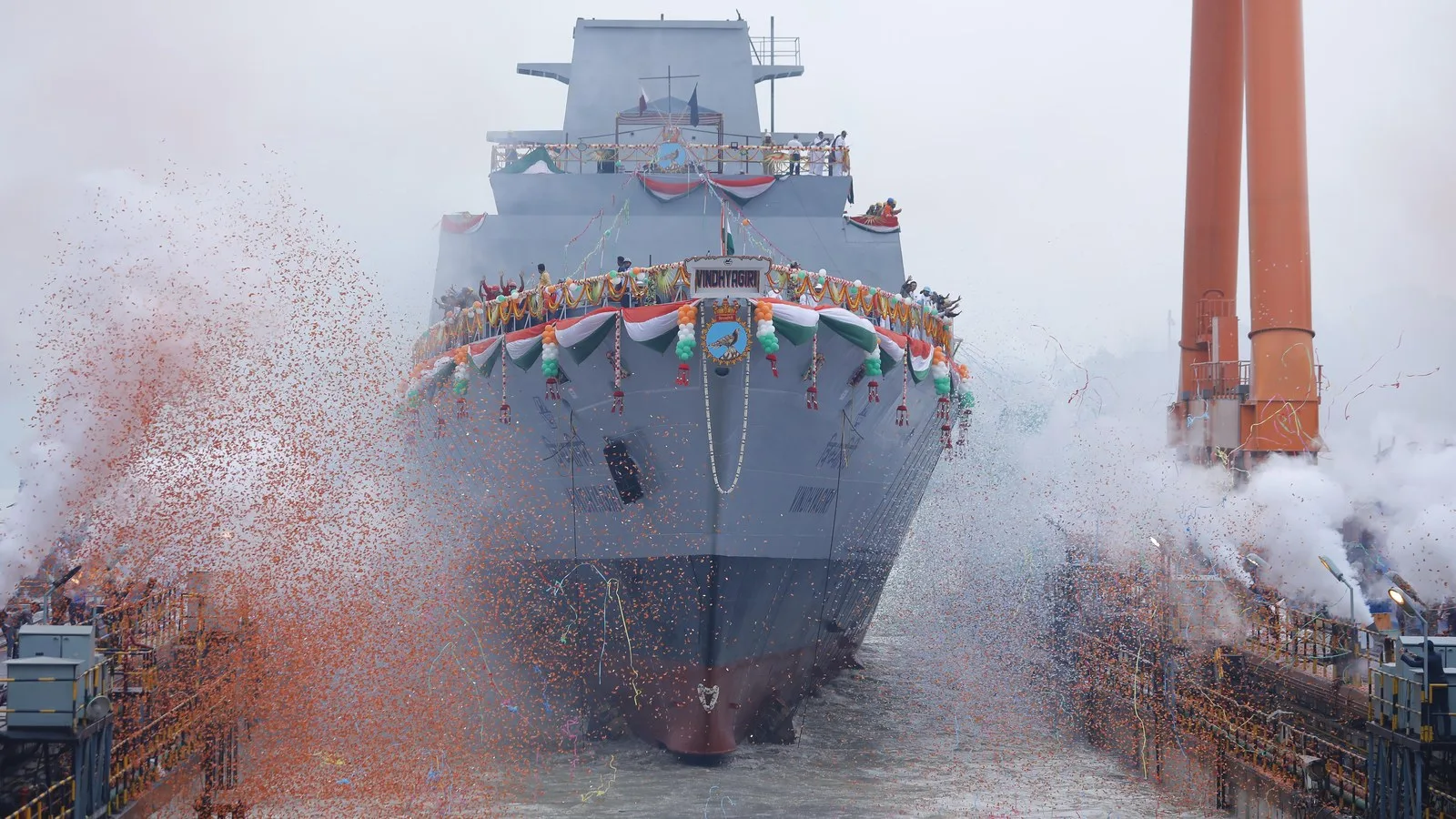
The Indian Navy received its seventh and final Nilgiri-class stealth frigate on Friday, 27 November, when Garden Reach Shipbuilders and Engineers (GRSE) in Kolkata handed over INS Vindhyagiri. The delivery completes the Project 17A programme, under which all seven ships have reached the Navy within 23 months of the first ship joining the fleet. Here is what the ship is, what it carries, and why the programme matters for Indian shipbuilding.
What happened on Friday
Vindhyagiri, known in the yard as Yard 3024, was formally accepted by Rear Admiral R. S. Dhaliwal of Headquarters Eastern Naval Command at GRSE in Kolkata. It is the third and final Project 17A frigate built by GRSE. The other four ships of the class were built by Mazagon Dock Shipbuilders in Mumbai.
The delivery marks the end of a run that began with the first ship of the class, INS Nilgiri, on 20 December 2024. All seven frigates have been delivered within 23 months of that date, a pace the Defence Ministry described as a major milestone in self-reliance in warship design and construction.
Vindhyagiri is the 811th vessel built and delivered by GRSE, and the 121st warship in the shipyard's history. It is expected to be commissioned into the naval fleet over the next few weeks.
What kind of ship is Vindhyagiri
Vindhyagiri is a 149-metre-long guided-missile frigate with a displacement of 6,670 tonnes. The Project 17A ships are the largest and the most sophisticated guided-missile frigates GRSE has built in its six decades as a defence shipyard.
The ship is designed as a versatile multi-mission platform, able to fight across three domains at sea:
- Anti-surface warfare, against enemy ships, with BrahMos supersonic cruise missiles that can strike targets at sea and on land. - Anti-air warfare, against aircraft and incoming missiles, with Barak 8 surface-to-air missiles. - Anti-submarine warfare, against submarines, with an advanced suite of sensors and weapons.
The frigates use Combined Diesel or Gas (CODOG) propulsion, which pairs a diesel engine with a gas turbine, and an Integrated Platform Management System that controls the ship's machinery from one place. They were designed by the Navy's Warship Design Bureau and overseen by the Warship Overseeing Team in Kolkata.
The class is a follow-on to the Shivalik-class frigates, and the Navy describes it as a generational leap in warship design, stealth, survivability and combat capability. The seven ships are Nilgiri, Himgiri, Udaygiri, Dunagiri, Taragiri, Mahendragiri and Vindhyagiri.
Why the 23-month delivery run matters
Speed is the striking part of this programme. Vindhyagiri was completed within 68 months of construction, compared with 84 months for the first ship of the class, INS Nilgiri. The Defence Ministry put the faster build down to the experience gained while building the six ships before it.
The programme also shows how warship building is now split between India's two big naval shipyards. GRSE built three of the seven ships and Mazagon Dock built four, with both yards working from the same design. That shared design, and the supplier base behind it, is what let the Navy take delivery of seven large warships in under two years.
For the Navy, the seven frigates add a full class of modern multi-mission ships to the fleet at a time when it is expanding its presence across the Indian Ocean. Each ship can operate on its own or as part of a carrier battle group, and each can switch between surface, air and submarine threats without returning to port to reconfigure.
The name, and the ship it replaces
Vindhyagiri is named after the Vindhyagiri mountain range in Karnataka. It is a reincarnation of the earlier INS Vindhyagiri, a Leander-class frigate that served in the Navy for 31 years, from 8 July 1981 to 11 June 2012.
Reusing the name is a Navy tradition. When an old ship retires, its name often passes to a new ship, carrying the record of the old ship's service into the new hull. The new Vindhyagiri was launched by President Droupadi Murmu on 17 August 2023, a little over three years before its delivery. Its keel had been laid on 5 March 2021.
What 75 per cent indigenous content means
The Project 17A programme has about 75 per cent indigenous content, according to the Defence Ministry. More than 200 micro, small and medium enterprises (MSMEs) supplied parts and systems for the ships. The programme generated work for about 4,000 people directly and more than 10,000 indirectly.
That figure matters because warships are among the hardest things a country can build for itself. The steel, the propulsion, the radars, the missiles and the combat systems all have to work together under combat conditions, and a country that can build them at home does not have to wait on foreign suppliers when it needs ships quickly.
The 75 per cent figure also means a quarter of the content still comes from abroad, including some high-end sensors and propulsion parts. The Navy's stated aim, under the Atmanirbhar Bharat push, is to keep raising the Indian share with each new class of ship.
What happens next
Vindhyagiri will be commissioned in the coming weeks, after which it will join the Eastern Naval Command. Sea trials and weapons work-up will follow before the ship takes up full operational duties.
With Project 17A complete, attention turns to the next generation of Indian-built warships. The Navy has said the experience of building seven frigates to one design, across two yards, in 23 months is the template it wants to repeat. Whether that pace can be held for larger and more complex ships, such as the next aircraft carrier, is the question the shipyards will now be judged on.
Frequently Asked Questions
What is INS Vindhyagiri?
INS Vindhyagiri is the seventh and final Nilgiri-class stealth frigate built under Project 17A. It is a 149-metre, 6,670-tonne guided-missile frigate built by GRSE in Kolkata and delivered to the Indian Navy on 27 November 2026.
What weapons does Vindhyagiri carry?
The ship carries BrahMos supersonic cruise missiles for anti-surface and land-attack roles and Barak 8 missiles for air defence, along with sensors and weapons for anti-submarine warfare.
Why is the delivery of Vindhyagiri significant?
It completes the Project 17A programme, with all seven frigates delivered within 23 months of the first ship. The programme has about 75 per cent indigenous content and involved more than 200 MSMEs.
Read More: Explained: What the Quad Summit in Manila Means for India
Read More: Explained: Pax Silica, the AI Pact India Just Signed
Read More: Explained: G20 Johannesburg Summit, Six Proposals by Modi
Read More: Explained: Why the Rupee Fell Sharply Against the Dollar

Comments
Be the first to comment on this story.