


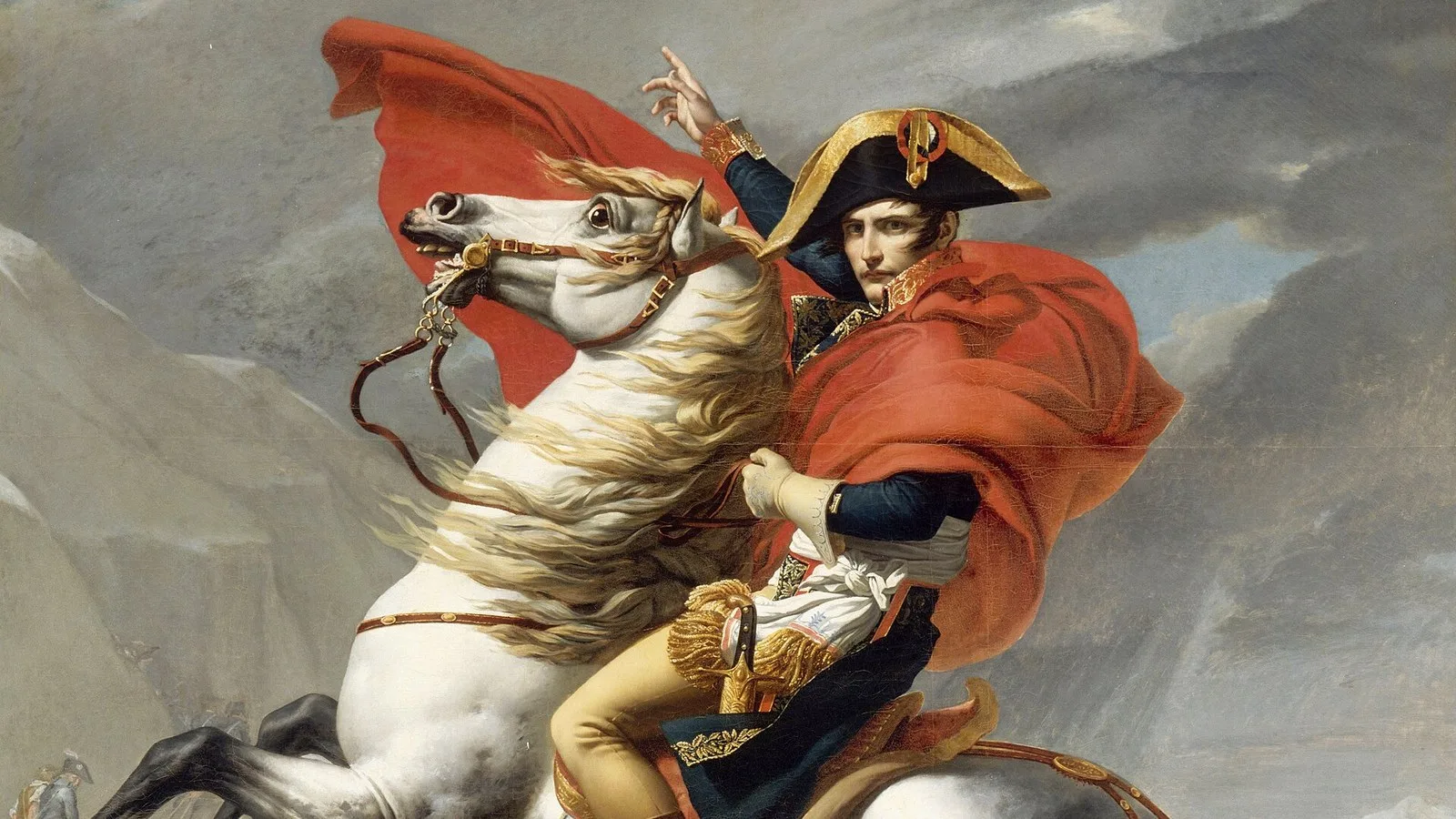
Ask anyone to describe Napoleon Bonaparte and the word short will come up within seconds. The image is fixed in popular culture: a tiny, furious emperor on a rearing horse, barking orders at men twice his size. It is also wrong. Napoleon was not short at all. His recorded height was 5 feet 2 inches, but those were French inches, and in modern measure he stood about 5 feet 6 inches, average for a Frenchman of his time. Verdict: False.
The claim
The claim is simple: Napoleon Bonaparte was unusually short, about 5 feet 2 inches tall, and his ambition, his wars and his temper were all an attempt to make up for it. The idea has a name, the Napoleon complex, and it is repeated in cartoons, comedy sketches and psychology books alike. It feels true because the pictures agree with it. British cartoons of the period show him as a pocket sized tyrant, and even today he is played on screen by short actors. But the claim rests on a measurement that was read in the wrong units, and on two hundred years of enemy propaganda.
What the records actually say
Napoleon died on Saint Helena on 5 May 1821, after six years in British custody. His height was measured after his death and recorded as 5 pieds 2 pouces, five feet two inches in French units. That is where the famous figure comes from, and it is also where the confusion starts. A French foot, the pied du roi, was about 32.5 centimetres long, while an English foot was about 30.5 centimetres. A French inch, the pouce, was about 2.7 centimetres, against 2.54 for an English inch. Convert the French figure properly and 5 pieds 2 pouces comes to roughly 1.68 to 1.69 metres, about 5 feet 6 or 7 inches in the measure used today. Read the same numbers as English units and you get a man of about 1.57 metres, short even by the standards of 1821. Generations of English language books made exactly that mistake.
The records back the taller reading. Napoleon's doctor Jean-Nicolas Corvisart said in 1802 that his patient was 5 foot 2 inches by the French measure, which he understood to be about 5 foot 6 in British measure. The post mortem carried out by the French doctor Francois Carlo Antommarchi recorded the same French figure. His valet Louis Marchand left a measurement of 5 pieds 2 pouces 4 lignes, which converts to about 1.686 metres. An English upholsterer on Saint Helena, Andrew Darling, recorded 5 feet 7 inches in English units, about 1.70 metres. Historians who have worked through all of these accounts, including Thierry Lentz of the Fondation Napoleon, put his height at about 1.68 to 1.70 metres. That was not short. Historians put the average height of a French man of the period at about 1.65 metres, so Napoleon stood a little above average. For comparison, Louis XIV, the Sun King, stood about 1.63 metres and added height with high heels. Napoleon needed no such help.
Why everyone thinks he was short
If the records are clear, why does the myth survive? The first reason is the cartoons. During the wars with France, British cartoonists led by James Gillray drew Napoleon as "Little Boney", a tiny, stamping, tantrum throwing figure. Britain feared invasion, and mocking the enemy's size was cheap and effective. The image stuck long after the wars ended, and it is still the way Napoleon is drawn today.
The second reason is his nickname. His soldiers called him "le petit caporal", the little corporal. It sounds like a comment on his height, but it was a term of affection, earned when he was a young artillery officer who worked alongside his gunners. He kept the nickname as a badge of honour, and his enemies took it literally.
The third reason is the company he kept. Napoleon surrounded himself with tall men. His Imperial Guard had minimum height requirements, so the soldiers standing closest to him in paintings and parades were deliberately chosen giants. Put an average sized man in the middle of a guard of tall soldiers and he looks short, even when he is not. The same trick works in reverse: a tall man looks taller among short people. Napoleon was an average man standing, in effect, against a tall backdrop.
The Napoleon complex
The height myth gave birth to a second idea, the Napoleon complex: the claim that short men compensate for their height with aggression, bossiness and oversized ambition. It grew out of the early twentieth century work of the psychiatrist Alfred Adler, who wrote about feelings of inferiority and the drive to overcome them. Popular writers later tied Adler's idea to Napoleon and gave it his name.
The label is not a diagnosis. It does not appear in the standard diagnostic manuals, and no doctor can diagnose it. Modern research finds only modest and mixed evidence that height shapes behaviour in the way the phrase suggests. The phrase is a figure of speech, closer to a stereotype than to a scientific term. And it rests on a false first step: Napoleon was not short, so even if the psychology were sound, it would not explain him.
Verdict: False
Napoleon Bonaparte was not short. His height was recorded as 5 feet 2 inches in French units, which converts to about 5 feet 6 inches in modern measure, average or slightly above average for a Frenchman of his time. The short Napoleon is a British cartoon that outlived the war that made it, helped along by a misread measurement, an affectionate nickname taken literally, and a guard of tall soldiers who made their emperor look small by comparison.
Frequently Asked Questions
How tall was Napoleon really?
About 1.68 to 1.69 metres, roughly 5 feet 6 or 7 inches. His height was recorded after his death on Saint Helena in 1821 as 5 pieds 2 pouces in French units. Because the French foot and inch were longer than the English ones, that figure converts to about 5 feet 6 inches in modern measure.
Why do people think Napoleon was short?
Three reasons. First, the French and English used the same words, feet and inches, for units of different lengths, so the famous 5 feet 2 inches was read in the wrong system. Second, British cartoonists led by James Gillray drew him as a tiny figure called "Little Boney" during the wars. Third, his Imperial Guard were chosen for height, so he looked short standing among them.
Is the Napoleon complex real?
No, not as a medical condition. It does not appear in the standard diagnostic manuals and cannot be diagnosed. It grew from Alfred Adler's early twentieth century writing on inferiority and compensation, later tied to Napoleon by popular writers. Research finds only modest and mixed evidence that height shapes behaviour this way, and the idea rests on the false claim that Napoleon was short.
Read More: Myths and Facts: A Duck's Quack Does Echo, Science Shows
Read More: Myths and Facts: Houseflies Do Not Live Only 24 Hours
Read More: Myths and Facts: Your Blood Is Not Blue Inside Your Body
Read More: Myths and Facts: Touching a Toad Does Not Give You Warts


Comments
Be the first to comment on this story.