


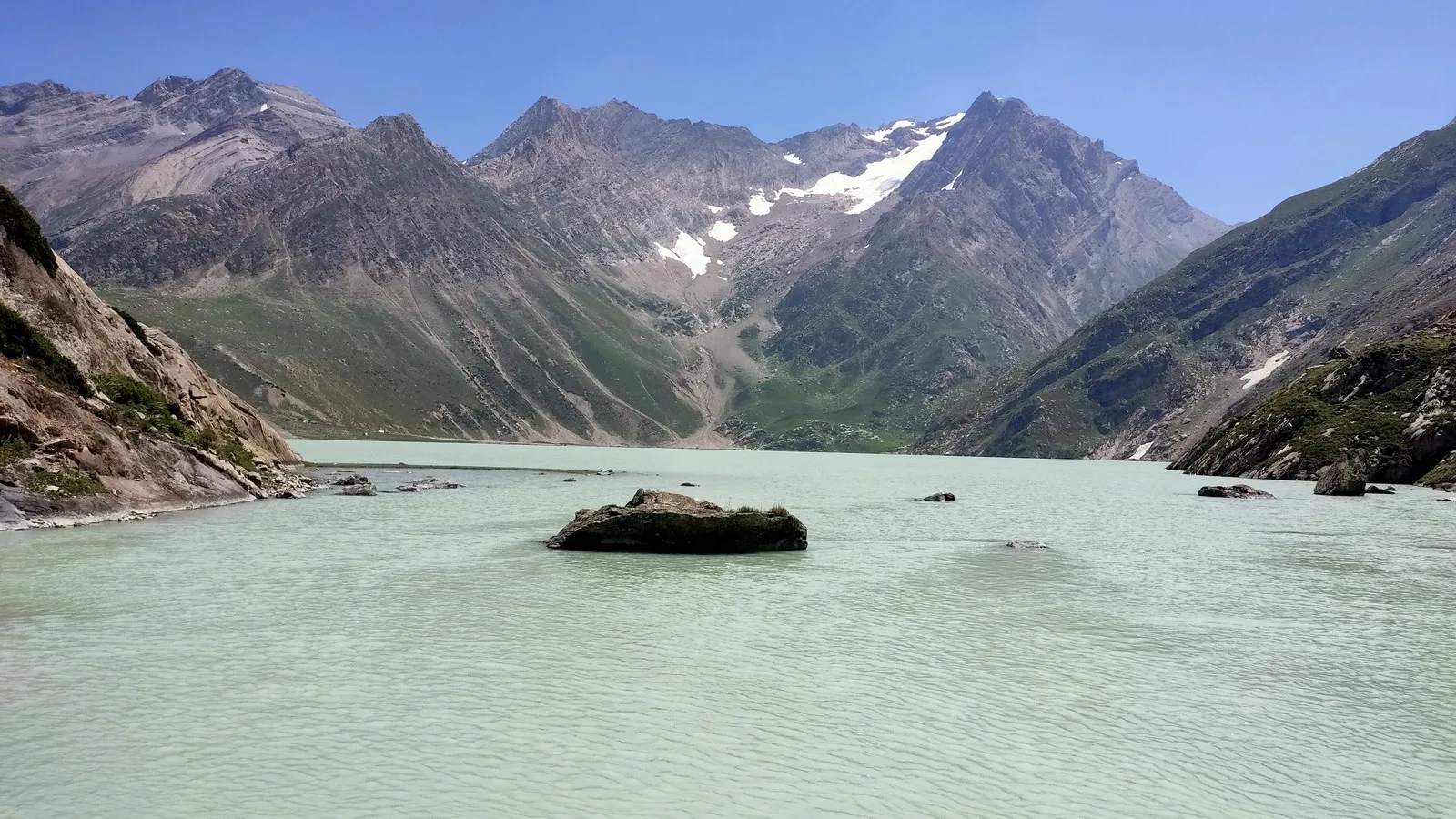
A viral video showing an earthmover operating near Sheshnag Lake, a high-altitude glacial lake in south Kashmir's Anantnag district, has sparked online outrage and street protests across Jammu and Kashmir. The clip was shot earlier this month by the operator of a Border Roads Organisation hired machine and posted to his Instagram account.
Environmentalists and political parties warn that heavy machinery in an ecologically fragile zone, already threatened by receding glaciers, risks irreversible damage. The Jammu and Kashmir government and the Border Roads Organisation say the video is misleading and the work is only maintenance of an existing pilgrimage track. Here is what the row is about.
What is Sheshnag Lake and why does it matter?
Sheshnag Lake sits at an altitude of 11,780 feet and spans roughly 1.1 km in length and 0.7 km in width. It is a vital stopover for devotees undertaking the annual Amarnath pilgrimage in south Kashmir's Anantnag district. Pilgrims historically reached it via a steep 13-km trek on foot, horseback, or palanquin after the macadamised road ended at Chandanwari, before covering another 18 to 20 km of unpaved terrain to the Amarnath cave shrine at 12,756 feet.
The lake sits in a region under severe climate stress. Pahalgam hosts major glaciers that feed the Jhelum River, including Kashmir's largest glacier Kolahoi, which has lost up to 24 percent of its area and 50 percent of its ice volume since 1962. Data presented in the Jammu and Kashmir Assembly this year showed authorities have mapped 616 glacial lakes across 12 districts, flagging 68 as potentially dangerous because of the rising threat of Glacial Lake Outburst Floods that can trigger devastating downstream flooding.
Dr Raja Muzaffar Bhat, chairman of the Jammu and Kashmir Climate Action Group, has cautioned that excavation around the lake risks destabilising its shape and threatening densely populated downstream areas. Activists have asked the administration for an independent scientific investigation into slope cutting, excavation, and debris dumping at the site.
What does the Jammu and Kashmir government say?
The government dispatched a 12-member inspection team, headed by a Forest Range Officer, to Sheshnag Lake on November 24. According to Forest Minister Altaf Kaloo, the team found the viral video misleading, and the work is actually taking place 200 to 300 feet away from the lake. Kaloo ruled out tampering and maintained that not a speck of earth has fallen into the lake.
The minister said the work falls under a 2025 Memorandum of Understanding signed between the Jammu and Kashmir government and the Border Roads Organisation's Project Beacon for the Amarnath tracks, covering maintenance of a 12-foot-wide access track designed solely to ensure safe passage for pilgrims. National Conference leader and legislator Tanvir Sadiq assured that the Omar Abdullah-led government will not permit any deviation in the project or allow any attempt to harm the fragile environment.
Control over the pilgrimage routes shifted after the revocation of Jammu and Kashmir's special status in 2019. The twin tracks to the Amarnath cave shrine, via Pahalgam and Baltal, were handed over to the Border Roads Organisation on September 6, 2022, for development, maintenance, and upgradation. Before that, the routes were managed by the Roads and Buildings Department and the Pahalgam Development Authority.
What has changed on the Amarnath route since 2022?
According to the Shri Amarnath Shrine Board, the previously narrow and steep Yatra paths along both routes have been widened to around 12 feet across most stretches, and the Kalimata stretch now has a much gentler slope. Sturdier handrails have been installed along the entire Baltal track and across 20 km of vulnerable stretches on the Pahalgam route. The Shrine Board has also set up grid power connectivity along the entire Baltal axis up to the holy cave, extending from the cave to Panjtarni, and introduced integrated command and control centres to monitor the pilgrimage.
What did the Border Roads Organisation say?
Dismissing social media claims of fresh construction as incorrect, the Border Roads Organisation clarified that the ongoing activity is strictly confined to widening and maintaining existing pilgrimage tracks. A BRO official said the agency is carrying out post-Amarnath Yatra maintenance based on past experience and feedback highlighting the need for wider paths to ease congestion and ensure safer passage for devotees.
The organisation said all work follows applicable safety norms and ecological safeguards, with measures in place to ensure safe disposal of excavated material, protect natural drainage, and minimise disturbance to surrounding terrain. By making these tracks safer and more accessible for pilgrims, Yatra personnel, and everyone else who uses them, the works serve the larger public interest, it added.
Why are Opposition parties in Jammu and Kashmir up in arms?
Opposition leaders across Jammu and Kashmir have raised the alarm, including former Chief Minister Mehbooba Mufti, CPI(M) leader M.Y. Tarigami, Apni Party president Altaf Bukhari, the Peoples Conference, the Awami Ittehad Party, the Aam Aadmi Party, and Kashmir's chief cleric.
Mufti, who tried to trek to the lake to inspect the site but was stopped by the Jammu and Kashmir Police, alleged that massive roads were being carved through the ecologically fragile Himalayan region using heavy machinery under the garb of pilgrimage. Pointing to recent Himalayan disasters, she warned people to look at what has happened in Uttarakhand and Nepal. She urged Union Road Transport and Highways Minister Nitin Gadkari to review the project and called on the Chief Minister to take up the issue with the Centre, stressing that Kashmir's forests, mountains, rivers, and springs are fundamental to its survival and must be protected.
Tarigami questioned the deployment of heavy earthmovers if authorities were merely maintaining an existing track, and called for an immediate halt to heavy machinery until experts examine it. He warned that cutting at the base of a slope removes its natural support and can set off landslides, while digging near a glacial lake can disturb the material around it, change the way water runs off, and push more sediment into the lake. He urged the Central and Jammu and Kashmir governments to jointly set up an independent panel of glaciologists, geologists, hydrologists, forest officials, and disaster-management experts to assess the site.
How has the Yatra changed over the years?
Turnout in the 1980s consisted largely of sadhus and hovered around 12,000 pilgrims, rising to roughly 42,000 by 1985. Before the Shri Amarnathji Shrine Board was set up in 2000, the pilgrimage was a brief 15-day affair. The surge in footfall over the past few years has pushed cumulative attendance to nearly 14.7 lakh pilgrims over the last three years, with 5.12 lakh devotees in 2024, 4.80 lakh in 2025, and over 4.80 lakh in 2026.
After a heavy rush and the deaths of 106 pilgrims in 2011, a seven-member committee headed by spiritual leader Sri Sri Ravi Shankar recommended sweeping reforms, including mandatory health certificates and age restrictions. In 2012, authorities capped daily footfall at 7,500 pilgrims each from the Baltal and Pahalgam routes. The limit was later revised to 10,000 pilgrims per route, allowing a combined total of 20,000 devotees per day.
The row now turns on a single question: whether the work near Sheshnag is routine maintenance of a pilgrim track, as the government and the BRO say, or heavy construction in a fragile glacial zone, as the protesters allege. The inspection team's report and the demand for an independent expert panel will decide which account stands.
Frequently Asked Questions
What is Sheshnag Lake?
Sheshnag Lake is a high-altitude alpine glacial lake in Anantnag district of Jammu and Kashmir, located at 11,780 feet on the Amarnath pilgrimage route. It spans about 1.1 km in length and 0.7 km in width and is a key stopover for devotees travelling to the Amarnath cave shrine.
What does the Jammu and Kashmir government say about the earthmover video?
The government says the viral video is misleading. A 12-member inspection team that visited the lake on November 24 found the work taking place 200 to 300 feet away from the lake, and Forest Minister Altaf Kaloo said not a speck of earth has fallen into the lake. The work is maintenance of a 12-foot-wide access track under a 2025 agreement with the Border Roads Organisation.
Why are environmentalists worried about the work near Sheshnag Lake?
Environmentalists warn that excavation near a glacial lake can destabilise the lake, disturb drainage, and push sediment into the water. The region is already under climate stress, with Kashmir's largest glacier Kolahoi losing up to 24 percent of its area since 1962 and 68 glacial lakes in the Union Territory flagged as potentially dangerous.
Read More: Explained: Ravi Hanj Book Row Over Basavanna, Four FIRs and a Red Corner Notice
Read More: Explained: New US Tariffs, Why India Has an Edge Over ASEAN and at What Cost
Read More: Explained: Constitution Day, Why November 26 Is Samvidhan Divas
Read More: Explained: 26/11 Mumbai Attacks, 18 Years On, the Trial and the Men Still Beyond Reach


Comments
Be the first to comment on this story.